
Build to Rent in Australia: What It Means for You
Build-to-rent (BTR) is a building constructed to be rented, not sold. One owner holds every apartment for the long term and manages the whole building as a single rental business. As an individual, you can’t buy a unit in one. You can live in one, and that makes it a question about your rent and your wealth plan, not about a property to buy. This guide covers how BTR works in Australia, what the tax rules require, the pros and cons for tenants, and how to put the idea to work in your own numbers. WealthStacker models the rent-or-buy choice over 15 years.
WealthstackerCompare Renting With Building WealthWealthStacker models rentvesting and buying strategies, helping you assess property decisions and potential net worth over time.VisitTL;DR
- BTR means purpose-built rental buildings held in single ownership. The AHURI definition says developers keep the units to rent out, at market rents or at a discount for affordable and social housing.
- Federal tax incentives apply to developments of 50 or more dwellings, held for 15 years, with at least 10% affordable tenancies (ATO).
- For tenants, the main attractions are longer leases and well-maintained buildings. The main concerns are premium pricing in early projects and a single landlord controlling many units.
- You can’t buy one apartment in a BTR building. The useful decision is whether to rent in one, or rent anywhere, while building wealth through your own property or share plan.
Table of Contents
- What build-to-rent actually is
- How big is BTR in Australia, and where is it being built?
- The tax rules that make BTR stack up for developers
- Build to rent: pros and cons for tenants
- BTR, an investment property or rentvesting: what’s the difference for you?
- How to decide: a five-step process for renters
- Worked example: one renter, two paths
- Where WealthStacker fits
- BTR, tax and your own return
- FAQ
- Sources
What build-to-rent actually is
Most Australian apartment blocks are built by a developer and sold off apartment by apartment to individual owners. Some of those owners live in the unit. Many rent it out. BTR flips that model.
According to the ACT Government, BTR housing is multi-unit rental housing built to be rented long-term, not sold. Each development has one owner and is managed as a single property. It is designed to offer secure, high-quality homes with shared spaces and facilities for residents.
Researchers at UNSW describe the contrast this way: BTR is purpose-built for rental occupation and held in single ownership as a long-term revenue-generating asset. Australia’s private rental market is mostly second-hand dwellings bought by small-scale investors, who are often motivated more by capital growth than by rental returns.
The UK and the USA have run BTR for years. AHURI notes the UK had over 149,000 BTR units completed or under development in 2020. Australia is catching up, helped by the 2023 Federal Budget’s cut to withholding tax penalties for international investors using managed investment trusts.

How big is BTR in Australia, and where is it being built?
The market is still small next to the traditional rental stock, but the pipeline is growing quickly. One media report on the national pipeline puts Sydney first for units under construction or in planning, Melbourne second and Brisbane third. The pipeline figures change with every project approval and cancellation, so treat any single number as a snapshot.
States are adding their own settings on top of the federal rules. The ACT, for instance, says non-unit-titled BTR projects can reduce land tax, general rates and levies, because those charges are fixed per title. Victoria, New South Wales and Western Australia each have their own planning and tax settings for BTR, so check the state government’s housing or planning site for your area.
The tax rules that make BTR stack up for developers
You don’t need to follow tax law to rent in a BTR building. The incentives still explain why these buildings are appearing, and why they come with conditions that affect tenants.
Treasury says the government cut the withholding tax rate on eligible fund payments from managed investment trusts attributed to new BTR developments from 30% to 15%. It also lifted the capital works deduction (the depreciation claim on construction costs) from 2.5% to 4% a year. The ATO’s business bulletin explains that this shortens the depreciation period from 40 years to 25.
To qualify, the ATO’s BTR page lists these requirements:
- construction commenced after 7:30 pm AEDT on 9 May 2023;
- 50 or more dwellings;
- ownership by a single entity for 15 years;
- lease terms of at least 5 years offered to tenants;
- at least 10% of dwellings as affordable tenancies.
If a development stops meeting the conditions inside the 15-year period, a misuse tax can claw back the deductions and withholding benefits claimed. Owners opt in by lodging a notice of events form (NAT 75663).
What changed for affordable tenancies
The Treasury Ministers’ release of 28 November 2024 said the legislation paves the way for 80,000 homes. It also set out the tenant-facing refinements: tenancies offered for a minimum of five years instead of three, affordable tenancies managed by community housing organisations, no no-fault evictions by BTR operators, and affordable rents capped at 74.9% of market value.
The ATO notes that the amended instrument applies from 27 March 2026. It requires dwellings for moderate- or lower-income households, at least 2% for lower-income households, and identification of eligible tenants by a community housing provider. The details move with legislation, so read the ATO page for the current rules.
Treasury also says the government will let foreign investors buy established BTR developments, with lower application fees. That widens the pool of capital behind these buildings.
Build to rent: pros and cons for tenants
What works in your favour
AHURI says BTR tenants benefit from long, stable leases that let them plan around things like children’s schooling. They may also be able to keep pets or make cosmetic changes. Buildings are often better maintained, because owners hold them for very long periods and can negotiate better maintenance deals.
The NSW Department of Planning and Environment fact sheet says BTR developers tend to focus on shared facilities, services and more communal space per apartment. Gyms, entertainment areas and workspaces can allow smaller but functional apartments.

UNSW researchers argue the single-ownership, long-horizon model addresses a gap in the traditional market. Small investor landlords often offer minimal security of tenure, which suits family households and low-income renters poorly.
What to weigh up
AHURI points to two concerns. Early Australian BTR projects were criticised for targeting high-end tenants with a luxury product, so the rent you pay often includes the amenities whether you use them or not. And when one owner holds many units in an area, there is a monopoly risk if they raise rents excessively or empty a building to refurbish or redevelop.
Affordable projects are emerging. AHURI says they typically sit inside larger developments, with affordable units usually 10% of the total and sometimes up to 30% without government subsidy, alongside higher market-rate units.
For most tenants, then, the practical test is simple: compare the all-in weekly rent, including any amenity charges, with similar apartments nearby, and check the lease term and the commute.
BTR, an investment property or rentvesting: what’s the difference for you?
BTR is not an investment you can make as an individual. It is an institutional product: large developers, funds and financiers build and hold whole buildings. Your own options as a first-home buyer, renter or investor sit in a different place.
| Path | What you hold | Who owns the asset | What it is built for |
|---|---|---|---|
| Renting in a BTR building | A lease, often longer than usual | One institutional owner | Stability and amenities |
| Buying an investment property | One property, usually second-hand | You | Capital growth and rent |
| Rentvesting | An investment property, while you rent where you want to live | You | Lifestyle flexibility plus a growing asset |
| Buying to live in | Your home | You | Home ownership |
The BTR tenant and the rentvestor have something in common: both rent the place they live. The difference is what happens to the money you would otherwise have put towards a deposit. If you choose a BTR apartment because you value a long lease and good facilities, the wealth question is where the rest of your savings goes. Our guides on rentvesting risks and how to grow wealth while renting go through that in detail.
How to decide: a five-step process for renters
1. Work out your real weekly cost of renting
Add the base rent, any amenity or parking fees and utilities. BTR buildings often package services, so a headline rent can look higher than the old-style apartment next door and still cover more. Do the same sum for each option.
2. Set your savings goal
Decide what you want the gap between rent and what a home-owner would pay to build towards: a deposit, an investment property, a share portfolio, or a mix. A goal with a number and a date turns a vague wish into a plan. Our portfolio building while renting guide walks through the options.
3. Check what you could borrow
Lenders assess income, expenses, debts and the deposit you hold. Knowing your borrowing power before you pick a suburb narrows the field fast. WealthStacker includes a borrowing power estimate for this step, so you can see your range before you start inspecting.
4. Compare scenarios over a long horizon
Rent-or-buy is a 10- to 15-year decision, not a monthly one. Rent rises, property growth, interest rates and your own savings all compound. WealthStacker’s 15-year modelling tools compare rentvesting and buying scenarios side by side, and show your projected net worth in each. That matters more than a single rent figure, because the answer depends on your income, deposit and the suburb you target.
5. Check yield and rent growth for any property you’d hold
If an investment property is part of the plan, look at its gross rental yield and the outlook for rental growth in Australia. BTR’s growth in supply is one of several forces on rents. WealthStacker has market research tools for Australian suburbs, plus hazard and risk overlays, to help you compare locations.
Worked example: one renter, two paths
Take a hypothetical renter on a stable income who has saved a deposit and is weighing a long-lease BTR apartment near work against two other routes: renting a cheaper older apartment and buying an investment property in a growth suburb, or buying a home to live in.
The figures that decide the outcome are all personal: the rent difference each week, the investment property’s price and yield, your loan repayments, and how long you stay. A BTR lease with amenities might cost more per week than an older rental. If that premium is offset by the stability you value, it can be a rational choice. But the money you keep investing is what builds wealth, and a modelling tool shows how a few hundred dollars a month changes your 15-year net worth.
That is why a single rule such as “renting is dead money” or “property always wins” rarely helps. Our comparison of why an investment property can beat paying rent sets out the case for the buying side. Only your own numbers show which applies to you.
Where WealthStacker fits
If you’re renting, in a BTR building or anywhere else, and wondering how to build wealth around your lease, WealthStacker gives you the dashboard to plan it. It provides free automated quarterly property valuations, a portfolio tracker for property, shares and crypto, goal and net worth planners, and 15-year modelling for rentvesting versus buying. There is also an AI chat assistant for questions about your scenarios. Our aim is that you don’t need spreadsheets to see where you stand.
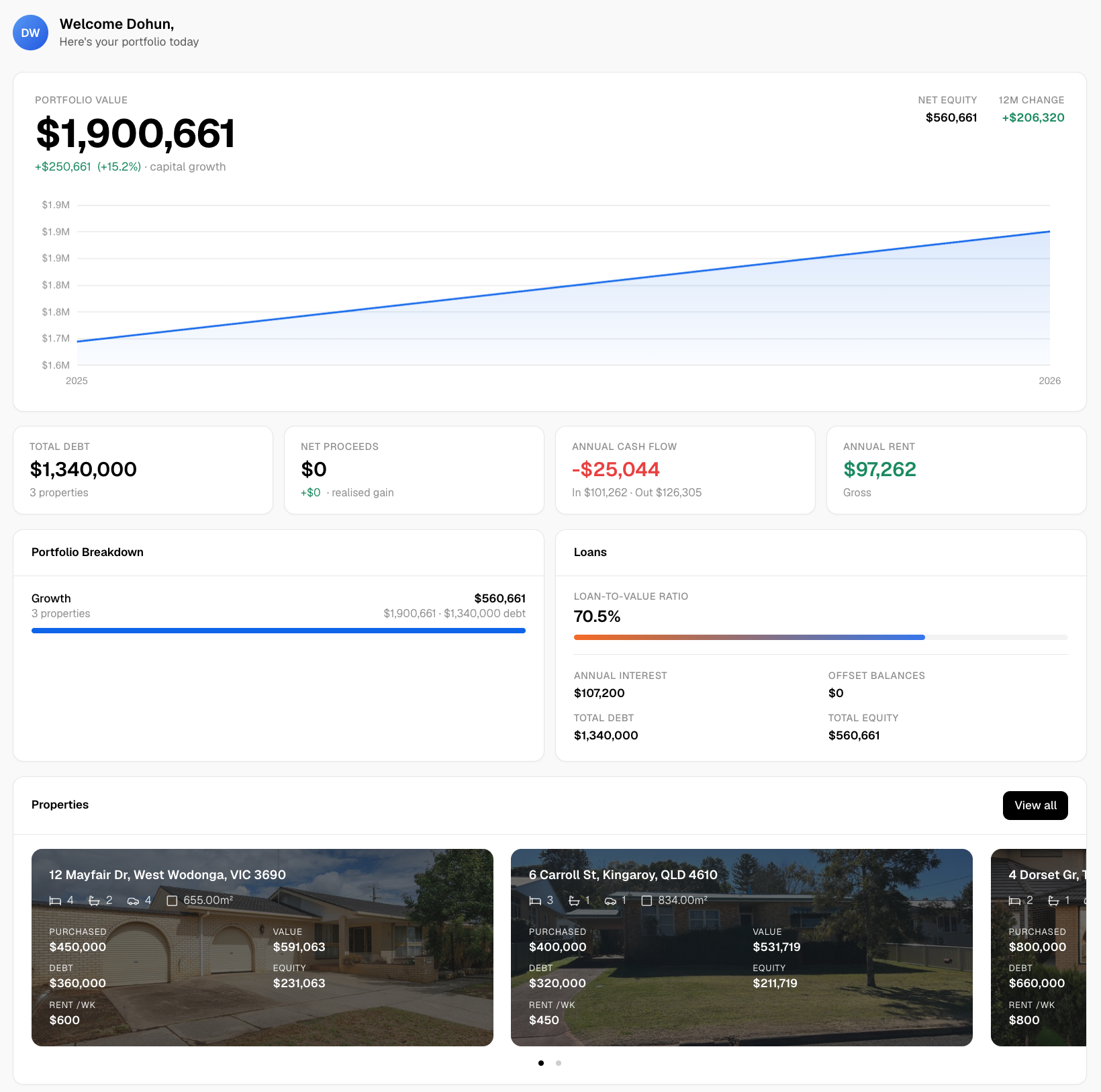
You can start with the free toolkit at WealthStacker and test a rentvesting scenario against buying with your own income and savings. Planners can do the same for clients who ask about renting in a BTR building while investing elsewhere.
BTR, tax and your own return
BTR tax incentives go to owners of qualifying buildings. They do not pass to individual tenants as a deduction, and they don’t change how you are taxed on your own investments. If you own an investment property of your own, depreciation, interest and rent are treated under the standard rules, so check specifics with a registered tax agent or the ATO. If you are a financial planner, the structure matters when clients ask whether BTR-related funds could suit them: that is a question for a licensed adviser, based on the client’s circumstances.
FAQ
Can I buy an apartment in a build-to-rent building?
No. The tax incentives require single-entity ownership for 15 years, so units are not sold individually during that period. The ATO states this as a condition for the incentives. If you want to own property, you would look at the regular market.
Is build-to-rent good for tenants?
It can be. AHURI says tenants may get long, stable leases, scope to keep pets or personalise the home, and well-maintained buildings. The concerns are higher rents in early luxury projects and the market power of a single large owner. Compare the full weekly cost and the lease terms with other rentals nearby.
Does build-to-rent lower rents?
The aim is to add rental supply. Treasury says the incentives were introduced to boost supply in the private rental market. Whether rents in a given suburb are affected depends on how many dwellings are built and what they are priced at. Affordable tenancies, at least 10% of dwellings in eligible developments, are capped at 74.9% of market value.
Is rentvesting better than renting in a build-to-rent apartment?
They solve different problems, and you can do both. Renting in a BTR building is about where you live. Rentvesting is about where your money works. Modelling both over 15 years on your own income and deposit shows which combination builds more net worth.
Sources
- What is ‘Build to rent’? | AHURI
- Develop build-to-rent housing in the ACT | ACT Government
- Build-to-Rent in Australia: product feasibility and potential, UNSW
- Build to rent development tax incentives | Australian Taxation Office
- New incentives for build to rent developments | Australian Taxation Office
- Better support for renters | Treasury
- Build-to-rent bill paves the way for the construction of 80,000 homes | Treasury Ministers
- Build-to-rent housing and flexible design fact sheet | NSW Department of Planning and Environment
- Australia build-to-rent pipeline surges past 60,000 units