
How the $67,000 HELP Threshold Affects Borrowing Power in Australia
Yes, a HECS or HELP debt typically reduces your borrowing power because lenders subtract your estimated compulsory repayment from your income before working out what you can afford to repay on a home loan. The size of the hit depends on your income, your lender’s methods and the APRA serviceability buffer applied to every application. The rest of this guide shows you how to estimate that impact and what you can do about it.
TL;DR:
- HELP debts reduce borrowing capacity mainly because lenders deduct the estimated compulsory repayment from your disposable income, which varies based on your income structure and lender policies.
- From July 1, 2025, HELP repayments shift to a marginal system, imposing smaller repayments on income just above the $67,000 threshold, potentially increasing borrowing power for some borrowers.
- The impact of HELP debt on borrowing is more significantly influenced by the 3 percentage point stress test applied to interest rates than by the repayment amount itself.
- Some lenders may exclude HELP repayments from assessments if the debt is expected to be repaid within a year, but practice varies and requires borrower demonstration.
- Using online borrowing calculators and making voluntary HELP repayments can help borrowers accurately model impacts and improve their borrowing power before applying.
WealthstackerModel Your Property Strategy ClearlyWealthStacker helps you assess borrowing power, compare rentvesting and buying, and explore potential net worth in real time.Explore WealthStacker
Table of Contents
- How lenders factor HELP repayments into your borrowing power
- 2025–26 HELP repayment changes and APRA consultation: what it means for you
- Worked example and how to use borrowing power calculators with HECS/HELP
- Practical steps to improve your borrowing power while carrying HELP or HECS
- How WealthStacker helps you model borrowing power with HELP
- Use WealthStacker to model your borrowing power with HELP
- Sources
- FAQ
How lenders factor HELP repayments into your borrowing power
When a lender assesses a home loan application, it does not just look at your income. It calculates your net disposable income (NDI): what is left after tax, living expenses, existing debts and any compulsory HELP repayments. That leftover amount is what gets tested against your proposed mortgage repayment.
Every serviceability assessment in Australia also applies a stress test. APRA requires lenders to add at least a 3 percentage point buffer above the actual loan rate when checking whether you could still afford repayments if rates rose. So a loan priced at 6% gets tested as if it were around 9%. This buffer, not HELP debt itself, is often the biggest single factor shrinking someone’s borrowing power.

Your compulsory HELP repayment is calculated on your repayment income, a figure that goes beyond your salary. It includes your taxable income plus items like reportable fringe benefits and certain investment losses, which means two people on the same salary can have different compulsory repayments if their income structure differs. Lenders typically estimate this repayment using ATO thresholds and deduct it from your usable income alongside your other commitments, such as car loans or credit cards.
Not every lender treats HELP identically. Some use the exact compulsory repayment figure from your latest tax return, others apply a standard percentage estimate based on your income bracket, and a handful may allow limited exceptions.
- Some banks ask for your actual compulsory HELP repayment as shown on your income statement.
- Others estimate it using a lookup table tied to income bands, which can overstate or understate the real figure.
- A small number of lenders will consider excluding the repayment if you can show the debt will be cleared soon.
This variability is exactly why the same income and HELP balance can produce different maximum loan amounts across different banks.
2025–26 HELP repayment changes and APRA consultation: what it means for you
The way compulsory HELP repayments are calculated changed in a way that matters directly to your borrowing power. From 1 July 2025, repayments moved to a marginal system, meaning you only pay a percentage on the income earned above the threshold, not on your whole income once you cross it.
The 2025–26 minimum repayment threshold sits at $67,000, and this figure is indexed annually, according to the Australian Taxation Office. For many borrowers, particularly those with incomes just above the threshold, this means a smaller compulsory repayment than under the old system, which taxed the entire income once the threshold was crossed. A smaller compulsory repayment leaves more assessed income available for loan servicing, which can nudge borrowing power upward compared with the previous rules.

Separately, APRA has been consulting on how authorised deposit-taking institutions should treat HELP debt in serviceability assessments. Because HELP repayments rise and fall with income rather than sitting at a fixed amount like a car loan, APRA has proposed clarifications that could let lenders exclude the repayment in limited cases, such as when the debt is expected to be repaid within roughly a year. This is not a blanket exemption. Lenders retain discretion, and the baseline expectation remains that HELP debt is factored into every assessment unless a borrower can clearly demonstrate an imminent payoff.
Worked example and how to use borrowing power calculators with HECS/HELP
Numbers make this easier to picture. Say a borrower earns $85,000 a year with a $25,000 HELP balance and no other debts.
- Under the marginal system, only income above the $67,000 threshold attracts a compulsory repayment, so the calculation applies to roughly $18,000 of income rather than the full $85,000.
- That compulsory repayment is deducted from the borrower’s assessable income before a lender calculates disposable income available for loan repayments.
- The lender then applies the 3 percentage point serviceability buffer to the loan’s interest rate, testing affordability at the higher, stressed rate rather than the advertised one.
- The combined effect of the compulsory repayment deduction and the buffer reduces the maximum loan amount the lender is willing to offer, compared with a borrower on the same income with no HELP debt and no buffer applied.
The buffer typically has a far bigger effect on the final number than the HELP repayment itself, since a couple of percentage points on a loan’s interest rate compounds over a 25 or 30 year term.
When you run your own numbers through a bank’s borrowing power calculator, check exactly which fields it uses. Does it ask for your HELP balance, your estimated compulsory repayment, or your gross income only? Some tools such as the Chino Hills Mortgage Calculator present these inputs differently again, which is a useful reminder that no two calculators produce identical results from the same numbers.
Pro Tip: Run your numbers through two or three different lender calculators and compare which one asks specifically about HELP or HECS debt, since the ones that ignore it may be overstating your borrowing power.
Practical steps to improve your borrowing power while carrying HELP or HECS
You cannot make a HELP debt disappear overnight, but there are legitimate ways to reduce its impact on a loan application or to boost your capacity elsewhere.
- Making a voluntary HELP repayment reduces your outstanding balance immediately, which can support a case for a lender exception if you are close to clearing the debt.
- Review whether reportable fringe benefits or salary packaging are inflating your repayment income, and speak with a tax adviser about whether restructuring is appropriate for your situation.
- Building a larger deposit, paying down credit cards or car loans, and using an offset account to reduce interest paid all free up more room in a lender’s serviceability calculation.
- A guarantor arrangement, where a family member offers equity as security, can sometimes offset the impact of a smaller deposit or lower disposable income.
Voluntary repayments deserve a closer look because of how they interact with the numbers. They do not reduce your compulsory repayment for the current year, since that is fixed by your income under ATO rules, but they do lower your outstanding HELP balance straight away. For some lenders, a smaller balance and a demonstrated intent to clear the debt soon is exactly the evidence needed to request an exception under APRA’s proposed guidance.
Pro Tip: If you are close to paying off your HELP debt, ask your broker to request a lender exception and bring documentation such as a payment schedule or bank statements showing the planned lump sum.
Brokers are worth involving early. They know which lenders use which method for estimating HELP repayments, which ones allow exceptions, and what paperwork (recent payslips, an ATO income statement, your HELP balance summary) speeds up an application.
How WealthStacker helps you model borrowing power with HELP
Free online tools let you build a realistic picture before you approach a lender. Automated quarterly property valuations and borrowing-power estimators allow you to enter your income, existing HELP balance and expected compulsory repayment, then see how a stressed interest rate changes your maximum loan size. You can also run rentvesting versus buying scenarios side by side, adjusting for a voluntary HELP repayment to see the practical difference it makes to your numbers before committing to either path.
Use WealthStacker to model your borrowing power with HELP
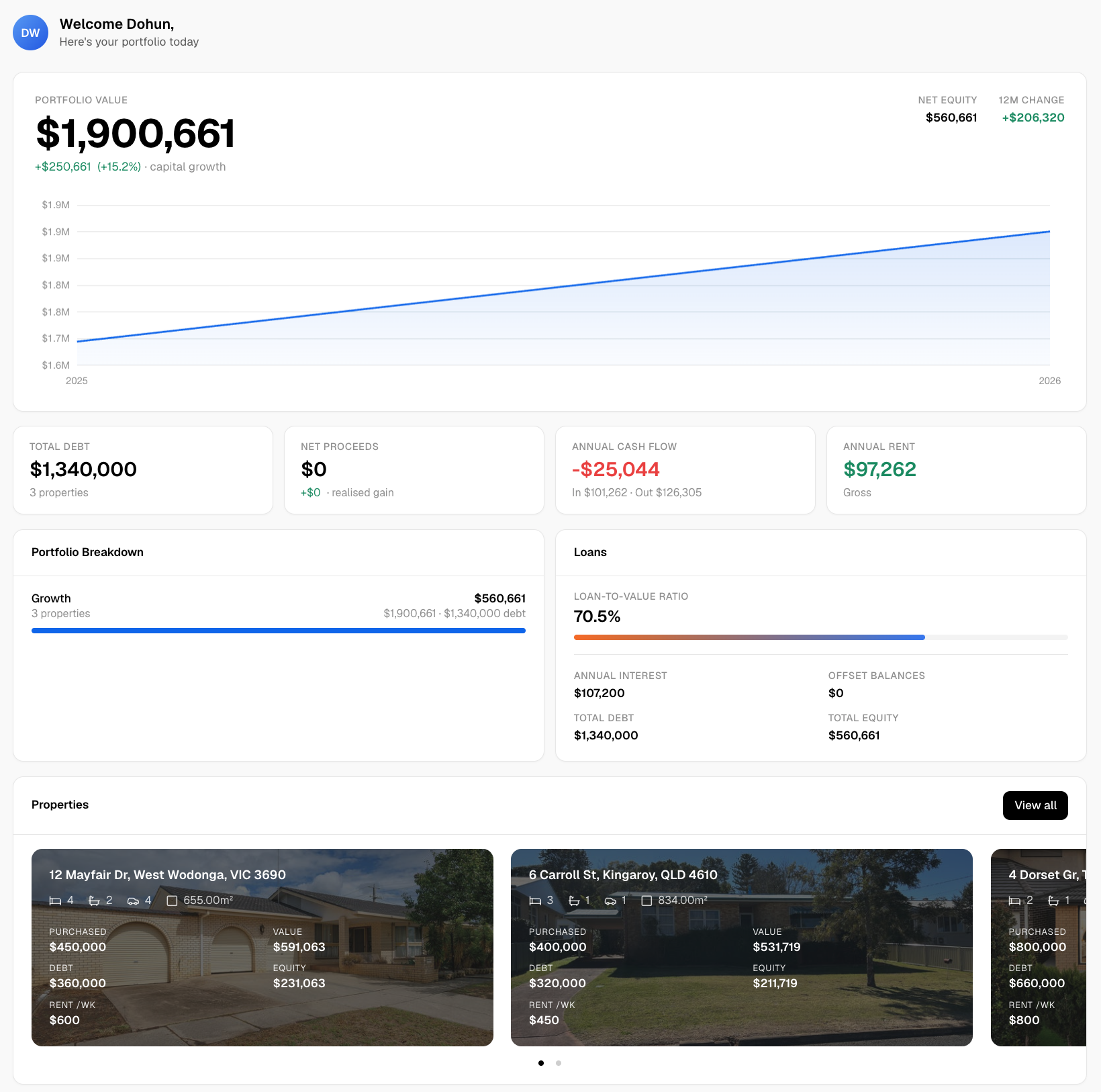
WealthStacker’s free scenario tools let you see how your HELP debt, income and a lender’s stress rate combine to shape your borrowing power, before you sit down with a broker. Model a voluntary repayment against doing nothing, then bring the comparison to your next conversation with a lender.
| Scenario | What it shows you |
|---|---|
| No voluntary HELP repayment | Your current compulsory repayment and its effect on assessed income |
| Voluntary HELP repayment made | Reduced HELP balance and potential case for a lender exception |
| Buying vs rentvesting | Side-by-side borrowing power and long-term wealth outcomes |
Start a free scenario at WealthStacker and see your own numbers before you apply.
This article is general information, not a substitute for advice from a qualified financial advisor. Consult a qualified financial professional about your own circumstances before acting on anything here.
Sources
- Study and training loans – what’s new | Australian Taxation Office
- Clarifying the treatment of HELP debt obligations | APRA
- Update on macroprudential settings | Prudential Handbook
- Loan repayments - Study Assist (Australian Government)
FAQ
Does HECS affect my borrowing power?
Yes, a HECS or HELP debt generally lowers your borrowing power because lenders deduct your estimated compulsory repayment from your income before assessing what loan repayments you can afford. The exact effect depends on your income, your HELP balance and how a particular lender calculates the repayment.
Is the government taking 20% off HECS?
No, there is no blanket 20% reduction to HECS or HELP debts. From 1 July 2025, repayments moved to a marginal system with a $67,000 threshold, meaning you only pay on income above that threshold rather than your full income once you cross it, which lowers many people’s repayments but is not a debt reduction.
How much HECS do I pay on $70,000?
Under the 2025–26 marginal repayment system, your compulsory repayment is calculated only on the portion of your income above the $67,000 threshold, so for a $70,000 income that applies to roughly $3,000 rather than the full $70,000. The exact percentage rate applied depends on your specific repayment income, so it is worth checking the current rate schedule directly with the ATO.
What is the HECS borrowing limit?
There is no single fixed borrowing limit for HELP loans, since the amount available depends on your course, provider and the type of HELP loan. What matters most for a home loan is not your available HELP limit but your current HELP balance and your compulsory repayment, both of which lenders factor into your borrowing power assessment.