
How to Avoid LMI in Australia: Six Routes That Work
You avoid lenders mortgage insurance (LMI) in Australia by borrowing 80% or less of the property’s value, or by using a route that removes the charge: a government deposit scheme, a professional waiver or a family guarantee. Which route suits you depends on your deposit, your job, your family situation and how long you are prepared to wait. The sensible way to choose is to put numbers on each path, including the cost of waiting, before you commit to any of them.
This guide explains what LMI is, how to work out your loan-to-value ratio (LVR), and what each route to avoiding LMI involves. It also covers refinancing, and how to compare “pay now” with “wait and save” using your own figures.
WealthstackerModel Your Property Investment OptionsWealthStacker helps you compare buying and rentvesting strategies with personalised modelling and real-time estimates of your potential net worth.VisitTL;DR
- LMI is a one-off premium that protects the lender, not you. It usually applies when you borrow more than 80% of the property’s value.
- The main ways to avoid it are a 20% deposit, the 5% Deposit Scheme, Help to Buy, a professional LMI waiver or a family guarantor.
- On an $800,000 purchase with a 5% deposit, an upfront LMI premium can reach $32,000, so the choice is worth modelling.
- Waiting to save a bigger deposit has its own cost in rent and rising prices. Compare both paths before you decide.
Table of Contents
- What LMI is and why lenders charge it
- Work out your LVR first
- Route 1: Save a 20% deposit
- Route 2: The 5% Deposit Scheme
- Route 3: Help to Buy shared equity
- Route 4: Family Home Guarantee and state programs
- Route 5: A professional LMI waiver
- Route 6: A family guarantor
- Smaller ways to lower your LVR
- Refinancing: does LMI follow you?
- Compare paying LMI with waiting
- Model it with your own numbers
- FAQ
- Sources
What LMI is and why lenders charge it
LMI is insurance that covers the lender if a borrower cannot repay and the property sells for less than the debt. Moneysmart, the government’s money guidance service, says it is usually a one-off cost when you borrow more than 80% of the property’s value. The lender is the insured party. You pay for a policy that you cannot claim on.
That last point matters. If a forced sale leaves a shortfall, the insurer pays the lender and may then seek the shortfall from the borrower or guarantor. LMI also does not follow you if you change lenders (more on that below).
The premium is paid at settlement. Most borrowers either pay it upfront or add it to the loan. Adding it to the loan is convenient, but you then pay interest on it for as long as it sits in the balance. GST applies, and stamp duty may apply depending on your state or territory.
How much does it cost? Lender information puts it at up to 6.5% of the loan amount, depending on loan size, LVR, property value and loan type. The premium depends mainly on loan size and LVR, not on your employment type or credit score. That means the lever you control is the size of your deposit relative to the price.
Work out your LVR first
LVR is the amount you borrow divided by the lender’s valuation of the property, shown as a percentage. Borrowing $400,000 against a $500,000 property is an 80% LVR. Go above 80% and LMI is usually triggered.
Three details catch people out:
- The valuation, not the price. The lender uses its own valuation, which can come in below what you agreed to pay. Lenders generally use the lower of the market valuation and a quick-sale valuation.
- Costs sit outside the loan. Conveyancing and stamp duty are not counted in the loan amount for LVR, but you still need cash for them.
- Lender and suburb caps. A lender may cap LVR differently by suburb, asking for a bigger deposit in some areas.
Here is a worked example. You want to buy at $700,000 and the lender values it at $700,000. To stay at 80%, you borrow at most $560,000, so you need a $140,000 deposit, plus your stamp duty and legal costs from separate savings. If the valuation comes in at $680,000, your maximum loan at 80% drops to $544,000, and the $16,000 gap lands on your deposit.
Route 1: Save a 20% deposit
This is the simplest route. A deposit of at least 20%, meaning an LVR of 80% or below, is described by the industry body for LMI providers as the most straightforward way to avoid LMI. It also reduces the loan and the interest you pay over its life.
The catch is time. In a rising market, the target moves while you save. A buyer saving for a $700,000 home needs $140,000 today, but if prices rise 5% by the time they get there, the 20% target becomes $147,000. Renting while you save adds another cost. This is why the question is rarely “can I avoid LMI” and more often “is avoiding it worth the wait”. Our guide on whether to pay LMI now or wait sets out that trade-off.
Route 2: The 5% Deposit Scheme
The federal 5% Deposit Scheme (formerly the First Home Guarantee) lets eligible first home buyers purchase with a small deposit and no LMI. Housing Australia says it provides a government guarantee of up to 15% of the home loan for first home buyers and up to 18% for single parents. The guarantee covers the gap between your deposit and the 20% a lender would otherwise want.
The rules loosened from 1 October 2025. Places became unlimited, income caps were removed and property price caps rose. Before that, the scheme had 50,000 places a year and income caps of $125,000 for individuals and $200,000 for couples.
Core requirements, per the mortgage industry’s July 2026 schemes guide:
- You must be an owner-occupier who has not owned property in the past decade.
- You must be an Australian citizen or permanent resident aged 18 or over.
- The minimum deposit is 5%, or 2% for single parents.
Price caps vary by location. Examples from that guide include $1,500,000 for NSW capital city, $950,000 in Victoria, $1,000,000 in Queensland and $850,000 in Western Australia, with lower caps in regional areas. Caps are reviewed, so check the official page before you shortlist properties.
The scheme runs through participating lenders, so you apply for the loan and the guarantee together. For other grants and concessions that can stack with your deposit, see our overview of first home buyer grants.

Route 3: Help to Buy shared equity
Help to Buy works differently. The government takes an equity share in your home, which cuts the loan you need. It requires a minimum 2% deposit and a loan from a participating lender. The government contributes up to 30% of the purchase price for an existing home or up to 40% for a new one, so you avoid LMI because your loan is small relative to the price.
Eligibility for FY2026 includes:
- Australian citizen, aged 18 or over.
- Taxable income at or below $103,000 for an individual, or $165,000 for single parents and joint applicants.
- Owner-occupier only, with no property owned in Australia or overseas (with exceptions for single parents).
- You cannot combine it with other government shared equity, loan or guarantee schemes.
That last rule means you choose between Help to Buy and the 5% Deposit Scheme. They suit different buyers. Help to Buy gives a smaller loan and shares future growth with the government. The 5% Deposit Scheme gives you full ownership, but a larger loan and repayments. Modelling both over a long horizon shows which leaves you better off.
Route 4: Family Home Guarantee and state programs
Single parents and single legal guardians may qualify for the Family Home Guarantee with a deposit as low as 2%. Several states also run low-deposit programs. Moneysmart lists the Queensland Housing Finance Loan, NSW First Home Buyers Assistance Scheme, SA HomeStart, WA Keystart and NT HomeBuild Access among programs that may help you avoid LMI. Terms differ by state and change, so confirm on the relevant government page.

Route 5: A professional LMI waiver
Some lenders waive LMI for borrowers in certain professions, often up to 90% LVR, with criteria varying between institutions. Westpac’s published broker policy shows how specific these can be. Its medical waiver covers dentists, GPs, hospital-employed doctors and specialists up to 95% LVR with no minimum income. Allied health professionals such as nurses, midwives, pharmacists, physiotherapists and psychologists can access a 90% LVR waiver with a $90,000 minimum income. Accounting and legal professionals can reach 90% LVR subject to accreditation, eligibility and income requirements.
A waiver does not mean a free loan. The lender may price the loan differently, and policies change. Our guide to LMI waiver professions lists who qualifies.
Route 6: A family guarantor
A family guarantee uses equity in a parent’s property as extra security, so you can borrow with a small deposit and no LMI. The industry body notes that these arrangements carry their own risks and legal considerations and that everyone involved should get independent legal and financial advice first. That advice is a real step, not a formality: the guarantor’s own home is on the line for the portion they guarantee. If you are considering a guarantee for an investment purchase, read about cross-collateralisation risks before you sign anything.
Smaller ways to lower your LVR
If none of the routes above fits, you can still push your LVR down:
- Choose a cheaper property. A lower price shrinks the loan needed for the same deposit.
- Wait for a revaluation. Lenders can reassess if market conditions improve.
- Use a gift from family. A larger deposit from a gift lowers the loan. Lenders have their own rules on gifted funds, so confirm them with your lender or a broker.
- Time the purchase. If your deposit is within a few thousand dollars of 20%, a short wait can save the whole premium.
Avoiding LMI is not free of trade-offs. A smaller deposit means less buffer between your loan and the property’s value, so a price fall bites harder. That is a reason to check your repayments and your cash buffer, whichever route you take.
Refinancing: does LMI follow you?
LMI is not transferable to another lender. If you refinance and your new lender wants a lower LVR than you currently have, you may pay LMI again. The test is your loan against the new lender’s valuation of the property.
If you bought with a small deposit a few years ago, your LVR has probably dropped through repayments and any price growth. A current valuation tells you where you stand before you apply. If you are at or below 80%, a refinance may not trigger LMI. If you are just above it, a modest extra repayment could take you under the line. Investors using equity should also read about the APRA buffer and tax risks of borrowing against equity, and how portfolio LVR is assessed.
Compare paying LMI with waiting
The real decision is rarely “avoid LMI at any cost”. LMI exists so lenders can offer loans to borrowers without a 20% deposit, which helps some buyers get out of the rental cycle sooner. Whether that is worth it depends on four numbers:
- The premium you would pay, upfront or capitalised into the loan.
- The rent you would keep paying while you save.
- The price movement in your target suburb while you wait.
- Your borrowing power at each point, since a larger loan has to pass the lender’s serviceability test.
Renters weighing this up should also consider rentvesting: living where you like while owning an investment elsewhere. Our rentvesting deposit strategy guide covers how deposits and APRA’s buffer interact. Borrowing limits are also affected by debt-to-income rules, so check those early. If you are building an investment plan around a first purchase, our first home buyer investment strategies guide is a good next read.
Model it with your own numbers
WealthStacker is built for exactly this comparison. It gives you free automated quarterly property valuations, so you know your current LVR without guessing. It also offers 15-year modelling that compares rentvesting and buying scenarios, borrowing power estimates, and an interactive net worth planner that shows how each path could play out over time.
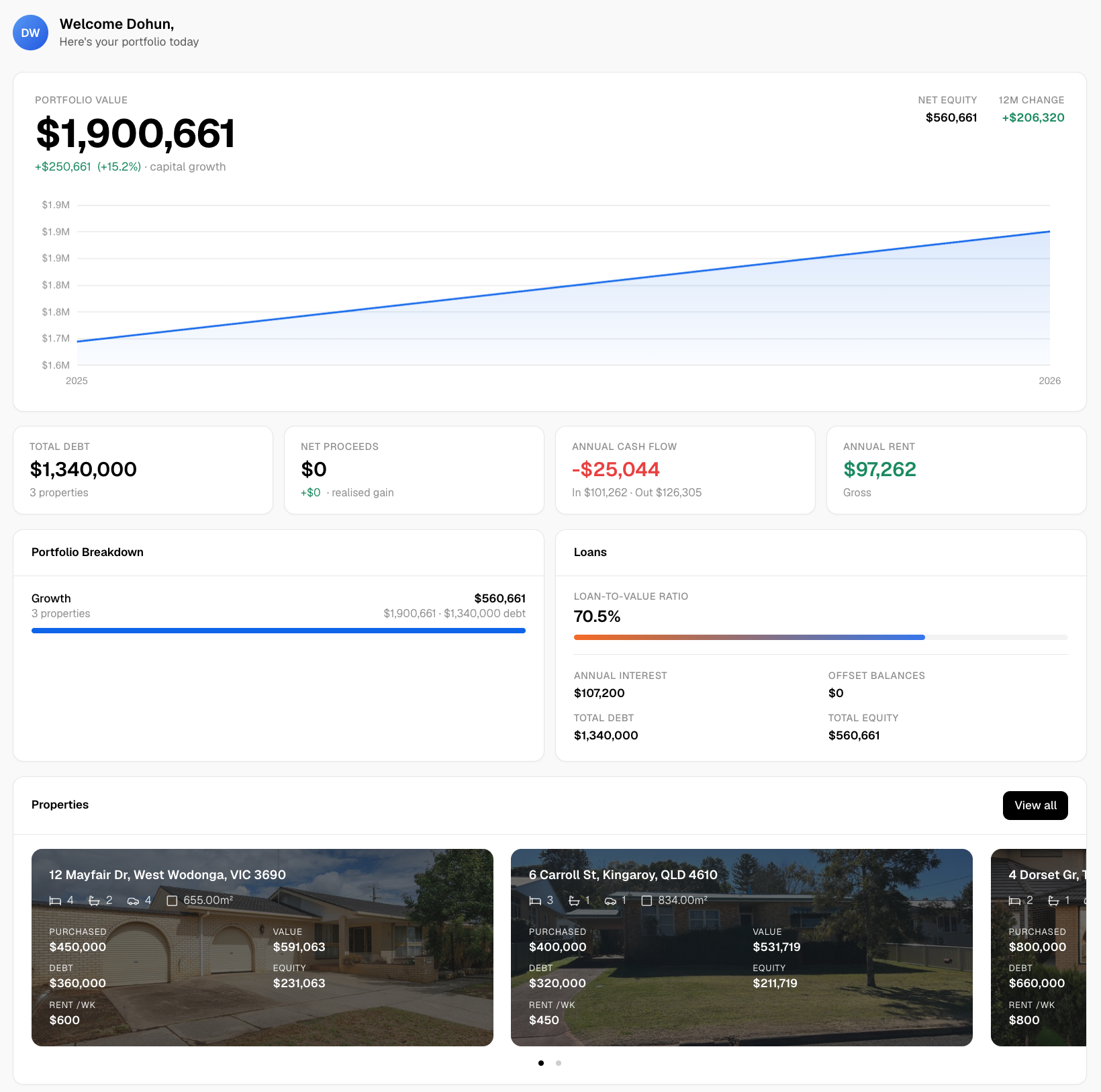
Put in your deposit, the price you are targeting and your rent, then compare “buy now with LMI” against “wait and save” side by side. You can start at WealthStacker.
FAQ
What is the LMI threshold in Australia?
LMI usually applies when your loan is more than 80% of the property’s value. That is a deposit of less than 20% on the lender’s valuation. Some lenders apply tighter limits in certain suburbs, so check with your lender.
Can first home buyers avoid LMI with a 5% deposit?
Yes, if they are eligible for the 5% Deposit Scheme. The government guarantees up to 15% of the loan (18% for single parents), so the lender treats the loan as lower risk. You must be an owner-occupier who has not owned property in the past decade.
Does LMI cover me if I can’t repay?
No. LMI protects the lender, and only the lender can claim on it. If a shortfall arises after a forced sale, the insurer may seek that amount from you or your guarantor.
Do I pay LMI again if I refinance?
Possibly. LMI does not transfer between lenders, so if your LVR is above the new lender’s limit, you may pay it again. A current valuation and your remaining balance show where you stand.
Sources
- Moneysmart: lenders mortgage insurance glossary
- Moneysmart: ways to buy a home sooner
- Office of Impact Analysis: Home Guarantee Scheme expansion analysis
- Housing Australia: 5% Deposit Scheme update
- Australian Government: Help to Buy Scheme
- MFAA: Home buying schemes in Australia, July 2026
- ALIC: Lenders mortgage insurance explained
- QBE LMI: Understanding LMI
- LMI key fact sheet
- How LMI works
- Understanding loan to value ratio
- LVR calculator and definition
- What is loan to value ratio
- Broker policy and LMI waivers