
AVM vs Appraisal: Which Property Value Should You Trust?
An AVM (automated valuation model) is a software estimate built from sales data. An agent appraisal is a selling estimate from a person who has usually seen the property. A bank valuation is a lender’s risk assessment, and a formal valuation is a written opinion from a licensed valuer. They answer different questions, so they often give different numbers. Use an AVM to screen and track, an agent appraisal to plan a sale, and a valuer’s report when a lender or a legal decision depends on the figure.
This guide explains how each one works, what they cost in Australia, why they disagree and which to use at each stage of buying, selling or investing.
Wealthstackerwealthstacker.com.auTrack Property Values Over TimeWealthStacker provides automated quarterly property valuations and investment modelling to help you assess real estate decisions with current market insights.Explore WealthStackerTL;DR
- An AVM is a fast, low-cost estimate from data. It cannot see inside a home, so treat it as a range, not a price.
- An agent appraisal estimates what a property might sell for. A valuation is a formal, written assessment by a licensed valuer.
- Banks value conservatively, so a bank figure can sit below your contract price or an agent’s estimate.
- Indicative valuation fees run from free for a desktop assessment to roughly $600 for a full inspection, depending on the lender’s risk rules.
- Use AVMs for screening and tracking, and a valuer when a lending or legal decision depends on the number.
Table of Contents
- What AVM means in Australian property
- The four “values” people confuse
- What an agent appraisal is, and what it is not
- How a bank valuation differs from market price
- Why the figures disagree
- What each option costs in Australia
- Which one to use, stage by stage
- Free property data in Australia
- Where WealthStacker fits
- A quick decision checklist
- FAQ
- Sources
What AVM means in Australian property
AVM stands for automated valuation model. It is software that takes recent sales, property attributes such as bedrooms, land size and location, and statistical rules, then returns an estimated value, usually with a range around it. No one visits the property.
Traditional valuers lean on the sales comparison method. In Australia that means looking at comparable sales, commonly within about 1 km and the last six months, and adjusting for differences. Mozo’s valuation guide describes this as the primary approach for residential valuations, and says AVMs are used for low-risk desktop assessments only. An AVM automates a version of the same comparison across thousands of properties at once. That is why it is fast and cheap, and also why it misses what only a person standing in the house would notice.
If you want the mechanics in more depth, our investor’s guide to automated property valuation models walks through the inputs and outputs.
The four “values” people confuse
People say “valuation” and “appraisal” as if they were the same thing. In practice there are four distinct figures.
| Type | Who produces it | Main purpose | Typical cost |
|---|---|---|---|
| AVM estimate | Software | Quick screening, tracking, desktop checks | Often free |
| Agent appraisal | Real estate agent | Setting a selling price or price guide | Usually no charge when you are considering listing |
| Bank valuation | Valuer instructed by the lender | Deciding how much the lender will lend | Often waived on the initial application |
| Independent valuation | Licensed or certified valuer | Formal, defensible opinion of market value | See the fee ranges below |
The distinction matters because each figure is built for a different decision, and none is “wrong” just because it differs from another.
What an agent appraisal is, and what it is not
An agent appraisal is an opinion on what your property might sell for in the current market. It is a selling estimate, not a formal valuation. Mozo explains that a property valuation is a written assessment by a licensed or certified valuer, based on comparable sales evidence and legally defensible, whereas an agent’s appraisal is not.
Agents bring context an algorithm lacks: the street’s buyer demand, how the kitchen presents, what similar homes attracted at recent open inspections. They also have a commercial interest in winning the listing, which is why you should compare more than one appraisal and ask for the sales evidence behind each.

There are also rules about how agents state their estimates. In Victoria, before you sign an authority to sell, the agent must give you an estimate of the selling price. Consumer Affairs Victoria’s guide says it must be a single amount or a range where the gap between top and bottom does not exceed 10 per cent of the bottom figure. If you are selling in that state, the Victorian agent estimate rules are worth reading before you compare appraisals. Rules differ by state, so check your own state’s consumer affairs body.
How a bank valuation differs from market price
A bank valuation answers a narrower question: how much can the lender safely lend against this property? It is not designed to tell you what a motivated buyer would pay.
Market value has a formal definition. It is the estimated amount for which an asset should exchange between a willing buyer and a willing seller in an arm’s length transaction after proper marketing, with both parties acting knowledgeably, prudently and without compulsion. That wording appears in the Parliament of Australia’s report on customer loans, which also notes that the High Court recognised the core principles of market value in 1907 in Spencer v. The Commonwealth.
Lenders tend to be cautious. Mozo notes that bank valuations are intentionally conservative, estimating what the lender could achieve in a forced sale rather than what a motivated seller could achieve at market. An independent valuation ordered by the owner may come in higher.
What a short valuation means for you
A short valuation happens when the bank values the property below your agreed purchase price. The lender then only lends against the lower figure. According to the same Mozo guide, your options are to fund the gap from savings, renegotiate the price, or commission an independent valuation and ask the lender to review its assessment.
This is where an early AVM check earns its keep. If a free estimate and the recent sales both sit well below the contract price, you know before exchange that a shortfall is possible and can plan your deposit accordingly. Our guide to property valuation reports for investors shows how to read the report once you have one.
Why the figures disagree
It comes down to information. An algorithm has data, while an agent has context. Sources that compare the two note that the gap tends to be smaller in suburbs with high turnover and uniform housing stock, and wider where property types are mixed, recent sales are few or the market is moving quickly.
In practice, the main reasons for a gap are these:
- Condition and features. An AVM cannot see inside the home or know about a renovation. Aspect, natural light, views and noise are also invisible to it.
- Thin sales evidence. Rural areas, unusual homes and quiet suburbs give the model few comparables.
- Timing. A model updates on the sales it has recorded. A fast-moving market can leave it behind.
- Purpose. A bank is pricing downside risk, an agent is pricing a campaign and an AVM is pricing the statistical middle.
A sensible habit is to read an AVM as a range, not a single price. A tight range in a busy suburb with similar houses is a stronger signal than a wide one on an unusual property.
What each option costs in Australia
AVM estimates are often free. Formal valuations are not, and the price rises with the depth of the assessment.
Mozo reports that lenders choose the valuation type according to loan-to-value ratio (LVR) risk:
| LVR band | Valuation type lenders typically use | Indicative cost |
|---|---|---|
| Below 60% | Desktop or AVM | Free to $200 |
| 60% to 80% | Kerbside | $200 to $350 |
| Above 80% | Full inspection | $300 to $600 |
Source: Mozo property valuation guide, 2026. The same guide notes most lenders waive the fee on the initial application.
If you commission a valuer yourself, expect to pay more for a deeper report, and ask the valuer for a written quote that includes GST. Commercial, rural and complex assignments cost considerably more than a standard home.
An agent appraisal is generally offered without a fee because the agent hopes to be engaged to sell. A free AVM tells you where to start, but nothing here replaces a quote for the exact service you need.

Which one to use, stage by stage
Researching a suburb or a purchase
Start with an AVM and public sales data. You are screening many properties, so speed and cost matter more than precision. Look at the estimate range, the recent comparable sales and the suburb’s turnover. Where the housing stock is varied, treat the estimate as a rough guide only.
Making an offer
Use the AVM range alongside recent sales you check yourself, and consider an agent’s view on the specific property. Then think about the lender. If your loan is at a high LVR, a full bank valuation is likely, and it may land below your offer price. Our guide to portfolio LVR for Australian investors explains how that ratio shapes what lenders ask for.
Selling
Get two or three agent appraisals, ask each for comparable sales, and use an AVM as a sanity check on where the market range sits. If the price matters legally, such as in a dispute or estate matter, a formal valuation from a licensed valuer is the right document.
Tracking an investment portfolio
Here the AVM is at its best. You do not need a $500 report each quarter to know whether a property’s value has drifted. Regular automated estimates show direction, and you pay for a full valuation only when a decision needs one, such as a refinance or a release of equity. Our piece on how often to revalue a property covers that rhythm, and when investors need a valuer rather than an AVM sets out the triggers.
Free property data in Australia
You can build a decent picture before spending anything.
- State valuer-general data. In NSW, the Valuer General’s portal lets you search land values and property sales for free, as NSW Government guidance explains. Other states publish their own land valuations and sales information, so check your state’s land or valuer-general body.
- Open government datasets. The NSW land value and property sales dataset lists land values for the past five years, the valuing year used for council rates, the valuation basis, zoning and sales information for individual properties from 2001.
- Free online estimates and suburb profiles. Several providers publish free property and suburb profiles with basic estimates, with deeper reports behind a paywall.
Note that council and land-tax valuations are land values for rating purposes. They are not market values of the house and land together, so do not treat them as a price.
Where WealthStacker fits
We built WealthStacker for the stage where a $500 report is overkill but guessing is risky. Our toolkit provides free automated quarterly property valuations, a dashboard to track your portfolio, borrowing power estimates and 15-year modelling that compares rentvesting with buying.
That means you can see an up-to-date estimate for the properties you own or are watching, then decide whether a lender’s valuation or a valuer’s report is worth ordering.
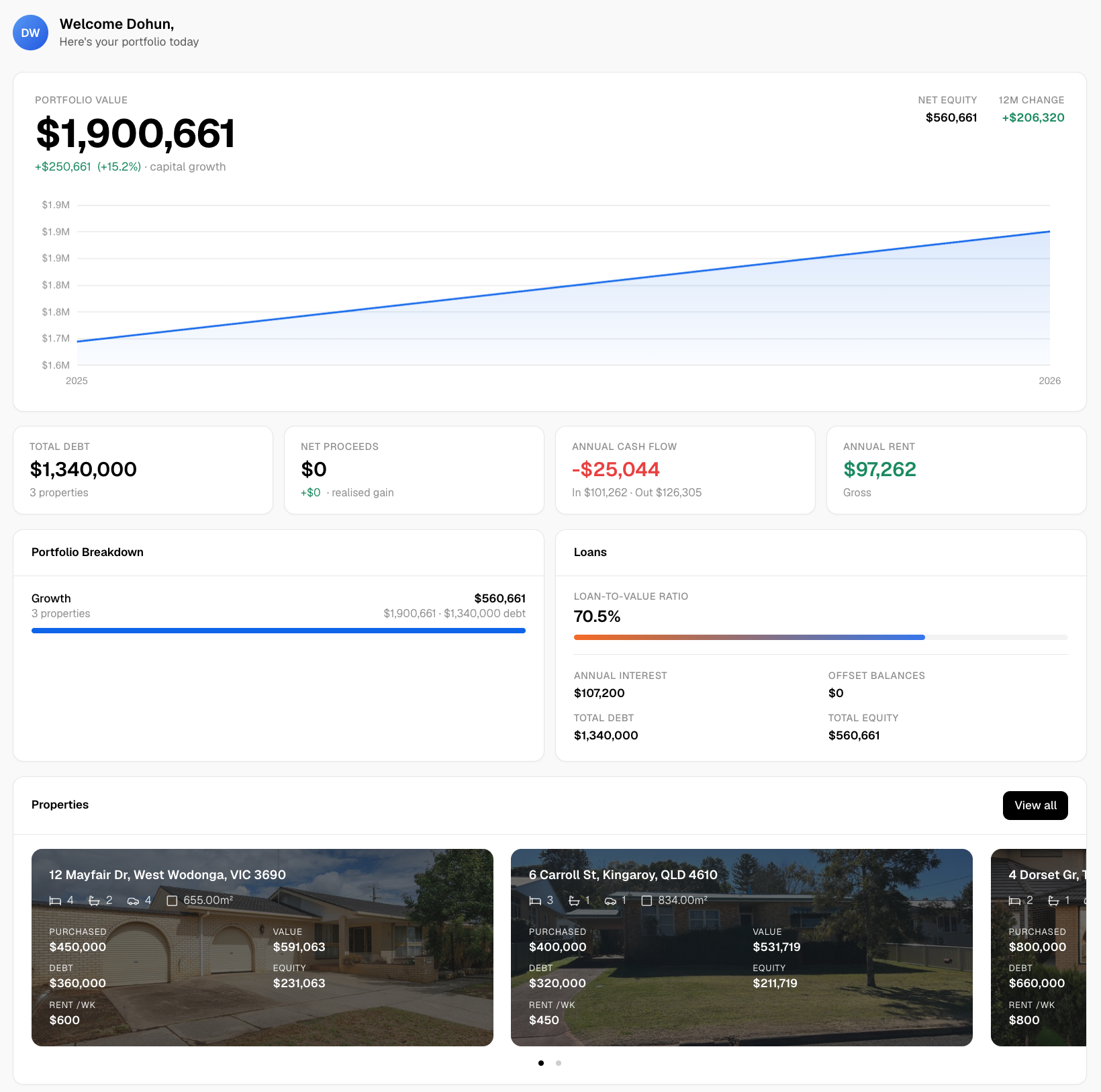
If you want to see your numbers, try the WealthStacker toolkit. Our valuations are automated estimates, designed for tracking and planning rather than as a substitute for a valuer’s formal report when a lender or a legal matter requires one.
A quick decision checklist
- Ask what decision the number feeds: screening, pricing a sale, lending or a formal dispute.
- For screening and tracking, use an AVM and read the full range.
- For selling, collect more than one agent appraisal with the sales evidence behind each.
- For lending, expect a bank valuation and prepare for it to be conservative. Know your LVR band before you apply.
- For legal or high-stakes uses, order a valuation from a licensed or certified valuer.
- If a bank values below your contract price, weigh the three options: fund the gap, renegotiate or seek an independent valuation and a review.
FAQ
What is the difference between a valuation and an appraisal?
A valuation is a formal written assessment of market value by a licensed or certified valuer, based on comparable sales evidence. An appraisal is usually an agent’s opinion of what a property might sell for. The first is a defensible document and the second is a selling estimate.
Is an AVM as accurate as an agent appraisal?
It depends on the property and the suburb. AVMs work best where there are many recent sales of similar homes, and are weaker for unusual homes or thin markets. They cannot see condition, renovations or views, so they give a range rather than a firm price.
Why did the bank value my property lower than the agent said?
Banks value conservatively, estimating what a lender could achieve if it had to sell, not the best price a motivated seller might get. If the valuation falls below your purchase price, you can fund the gap, renegotiate or commission an independent valuation and ask the lender to review.
How much does a property valuation cost in Australia?
Mozo’s 2026 guide gives indicative ranges: desktop or AVM from free to $200, kerbside $200 to $350 and a full inspection $300 to $600. Most lenders waive the fee on the initial application. Ask any valuer for a written quote before you book.
Sources
- Property valuation: what is it and how much does it cost (Mozo)
- Real estate: a guide for buyers and sellers (Consumer Affairs Victoria)
- Customer loans, Chapter 5 (Parliament of Australia)
- Working out what home to buy and where (NSW Government)
- NSW land value and property sales web map (data.gov.au)
- Selling a House As-Is: How It Works and What You Net