
Airbnb vs Renting in Australia: Which Earns More?
Short-term letting on Airbnb usually brings in more per booked night, but a long-term tenant often closes the gap once you count empty nights, cleaning, platform fees and your own time. Which one wins for your property depends mostly on location, occupancy and the rules in your state and council area. In a premium tourism area, short stays can come out ahead. In most suburbs, a long-term lease gives steadier cash flow for less work.
This guide shows how to compare the two on the numbers that matter, what the research says, which rules can change the answer, and how to test your own property before you switch.
WealthstackerCompare Property Strategies With More ContextWealthStacker’s investment toolkit combines automated quarterly valuations and personalized modeling to help you assess property decisions.Explore the investment toolkitTL;DR
- Airbnb earns more per night, but weekly returns narrow once you factor in vacancy. Research from Victoria’s Parliamentary Budget Office found the differences are less dramatic than nightly rates suggest.
- Long-term rentals give more predictable income and lower running costs. Short stays add cleaning, utilities, management and more wear.
- Location decides it. AHURI research points to short stays sometimes outperforming in premium tourism areas.
- Check state, council and strata rules before you list. Caps, registration and levies can change your numbers or rule out Airbnb entirely.
- Compare net income after all costs, not headline nightly rates.
Table of Contents
- What actually differs between Airbnb and a long-term rental
- Income: why Airbnb looks better than it is
- Costs and workload
- Location decides the winner
- Rules that can change the answer
- Tax: mostly the same, with one key habit
- Flexibility: the real advantage of Airbnb
- Broader effects to be aware of
- How to decide: a five-step test
- Who should choose what
- Think about the whole portfolio, not just one property
- Model it before you commit
- FAQ
- Sources
What actually differs between Airbnb and a long-term rental
The two models look similar from the outside: a tenant or guest pays to live in your property. The structure underneath is different.
Airbnb (short-term letting) means nightly rates for stays of days to weeks, in a fully furnished property. You or a manager handle bookings, turnovers, guest messages and restocking.
Long-term renting means a fixed weekly rent under a formal tenancy agreement, typically six to twelve months or longer, often unfurnished or lightly furnished. This is the model described by Covara as the standard alternative to short stays.
The legal footing differs too. Long-term tenancies fall under state and territory residential tenancy law, which governs bonds, rent, maintenance and tenant rights. Short-term holiday rentals generally do not need to apply that legislation. That gives you more freedom over who stays and when, but it also means different local rules apply, covered below.

Income: why Airbnb looks better than it is
Headline comparisons almost always show a short-stay nightly rate against a weekly rent. A $250 night looks far better than a $700 week. It stops looking so good once you ask how many nights you actually book.
The Victorian Parliamentary Budget Office notes that nightly returns are often higher, but average weekly returns show less dramatic differences once occupancy is included. It also flags that short-stay returns are highly sensitive to uncertain market data, so any single figure you read online deserves caution.
The occupancy threshold
A study of Melbourne by Krause and Aschwanden, published through the Real Estate Research Institute, found that a short-term rental generally needs an occupancy rate of around 40% to have better than a 50% chance of outperforming the revenue of a long-term rental. That is a Melbourne finding from an older dataset, so treat it as a sense of scale rather than a rule for your suburb. Still, it shows that the break-even point is not 100% or even 70%. It is lower than many owners fear, but it is a real hurdle in slow seasons.
A simple worked example
These figures are illustrative only, not market data. Suppose a two-bedroom apartment could rent long-term for $650 a week, or $33,800 a year if it is occupied all year.
On Airbnb, assume $210 a night at 55% occupancy. That is about 201 booked nights, or roughly $42,200 gross. Now subtract:
- Platform and payment fees
- Cleaning between stays (often recharged to guests, but not always fully covered)
- Utilities and internet, which you now pay
- Consumables, linen and replacement of small items
- A property manager, if you use one. A Queensland-based host management guide puts the typical manager charge at 10% of monthly revenue
- Furnishing and fit-out, a one-off cost that also needs replacing over time
After those items, a gross gap of about $8,000 can shrink a lot, and in a soft year it can reverse. The point is not that Airbnb loses. The point is that you have to run your own version of this calculation with your own inputs.
Costs and workload
Costs are where the two models diverge most.
| Factor | Airbnb (short-term) | Long-term rental |
|---|---|---|
| Income per night or week | Higher per booked night | Fixed weekly rent |
| Income stability | Varies by season and demand | More predictable |
| Running costs | Cleaning, utilities, consumables, platform fees | Usually lower; tenants typically pay their own utilities |
| Management time | High, or a manager’s cut | Low, or a letting agent’s fee |
| Maintenance | More frequent | Less frequent |
| Furnishing | Required | Usually not |
| Owner use | Block out dates | Not possible during the lease |
| Legal regime | Local STRA rules, not tenancy law | State residential tenancy law |
Operating expenses are generally higher for short stays because of cleaning after each stay, utilities and more frequent maintenance, whereas long-term tenants typically pay their own utilities and need less upkeep, according to the host management guide above. A Sydney Morning Herald analysis adds that short lets bring cleaning and management costs and extra work, and can be harder to fill in winter. It also notes that longer leases can avoid the cost of re-advertising.
Wear and tear, and risk
The risks are different rather than simply bigger or smaller. Frequent turnover means more wear on a short-stay property. Long-term risks tend to centre on late or missed rent, lease disputes and neglect, as Covara outlines.
Interestingly, a 2025 AHURI report found owners link short-term letting with higher workloads and security concerns, yet also see a lower risk of serious long-term property damage than with a traditional tenancy. Both pictures can be true at once: more small problems, fewer large ones.
Location decides the winner
Profitability depends on location and market conditions. AHURI’s 2025 report says short stays can outperform in premium tourism areas, while long-term renting delivers more predictable cash flow. That fits what most owners see on the ground:
- Holiday and event locations with strong year-round or seasonal demand favour short stays, especially when the owner also wants personal use.
- Inner-city apartments can work for short stays, but are often the most tightly regulated and the most exposed to strata restrictions.
- Ordinary suburban housing with a deep pool of long-term renters usually does better on a stable lease with minimal effort.
The same logic applies abroad. A coastal rental investment example from Spain shows how location, occupancy and yield shape the final return, which is a useful reminder that the property’s setting matters as much as the model you choose.
Whichever way you lean, look at yield as well as income. Our guides on gross rental yield and on why rental yield matters explain how to turn a rent figure into a return you can compare across properties.
Rules that can change the answer
This is the section many owners skip, and it is where Airbnb plans most often fall over. Rules differ by state and often by council, so confirm the current position with your state government and local council before you buy furniture.
New South Wales
In NSW, non-hosted short-term rental accommodation is capped at 180 days a year in Greater Sydney and specific local government areas such as Byron Shire and Ballina, with an exemption for bookings of 21 days or longer, according to the NSW Planning Portal FAQ. Properties must also be on the state STRA register, which captures fire safety and day-limit compliance. Ballina Shire Council’s factsheet adds that strata by-laws may prohibit short stays altogether.
A 180-day cap changes the comparison directly. If you can only let non-hosted for half the year, you need to fill the other half with something, and a long-term lease is not easy to combine with that.
Victoria
Victoria introduced a 7.5% short stay levy from 1 January 2025, along with registration obligations, and councils can add their own rules such as night caps. A compliance guide for Victorian hosts summarises the changes. The Parliamentary Budget Office paper above looked at the impact of a 90-day cap on short stays, which shows how seriously the state has examined limits. Check the State Revenue Office and your council for the current settings.
Other states and strata
Other states and territories have their own approaches, and they change. The consistent trap is strata. An owners corporation may restrict or ban short-term letting, so read your by-laws before running any numbers.
Tax: mostly the same, with one key habit
The Australian Taxation Office requires rental income, short-term or long-term, to be declared in full as gross income before fees or commissions are deducted. Expenses for part-property rentals, such as a spare room, are apportioned using floor area and access to common areas, adjusted for the days rented, as the ATO guidance on renting out a room explains.
An Airbnb tax guide for Australia says Australia generally does not treat short-term accommodation differently from long-term rentals for income tax. Expenses are apportioned by the extent and period the property is rented or genuinely available for rent.
The practical habit: keep clean records from day one, separate costs for the rental from your own use, and speak to a registered tax agent about your situation. If you let a home you also live in, or use it yourself part of the year, apportionment gets more complicated and is worth professional advice.

Flexibility: the real advantage of Airbnb
For many owners, flexibility is the deciding factor rather than income. Short-stay letting lets you block out dates for your own use or adjust availability, which a fixed lease does not allow, as Covara notes. The Parliamentary Budget Office makes a similar point: short stays suit owners who want flexibility of use, such as people with a holiday property or who live in another city.
If you want that dual use, a long-term lease is the wrong tool. If you want a hands-off income and never plan to stay there, flexibility has little value to you.
Broader effects to be aware of
Short-term letting is part of a wider housing debate. AHURI research from 2018 found that it can remove homes from the long-term rental market in high-demand inner-city areas, contributing to unaffordability. That is one reason governments keep tightening rules, and it is a reason to build some regulatory change into your plan rather than assuming today’s settings last.
How to decide: a five-step test
- Find your realistic long-term rent. Use recent leases for similar properties nearby, not asking prices alone. Our piece on forecast rental growth in Australia helps you think about where rents are heading.
- Estimate honest Airbnb occupancy. Use a conservative number, and one that accounts for winter or off-peak periods.
- List every cost. Fees, cleaning, utilities, insurance, management, restocking, furniture replacement, and the levy or registration costs where they apply.
- Check the rules. State caps, council registration, strata by-laws and loan or insurance conditions.
- Compare net, annual, risk-adjusted income. Then ask how much of your own time the higher figure costs you, and whether the gap pays for it.
If the net gap is small, the long-term lease usually wins on simplicity. If it is large and rules allow, short stays deserve a trial season before you commit to furnishing everything.
Who should choose what
Airbnb tends to suit owners in strong tourism or event locations, owners who want personal use of the property, and owners who enjoy hosting or have a trusted manager and the margin to pay one.
A long-term rental tends to suit investors who want predictable cash flow, owners of ordinary suburban property, anyone living far from the property, and those with little appetite for turnovers and guest issues. It also keeps the property inside the standard tenancy framework, with its clear rights and processes.
There is also a middle path some owners take: a long-term lease for most of the year, with the option of short stays in a defined season where rules allow. Check that your lease, strata and local rules permit it first.
Think about the whole portfolio, not just one property
The choice between Airbnb and a tenant is a single decision inside a bigger plan. If you are still deciding whether to buy at all, or to keep renting where you live and invest elsewhere, our guides on renting versus buying, rental yield versus capital growth and rentvesting risks cover the trade-offs. For benchmarks, see real estate ROI benchmarks, and for longer horizons, long-term property projections.
Model it before you commit
WealthStacker is built to help Australians test property decisions with numbers rather than guesses. You can get free automated quarterly valuations, track your portfolio, and use 15-year modelling tools to compare rentvesting and buying scenarios, along with borrowing power estimates. Running your rental income assumptions through a longer-term model shows whether a higher-income, higher-effort strategy really moves your net worth.
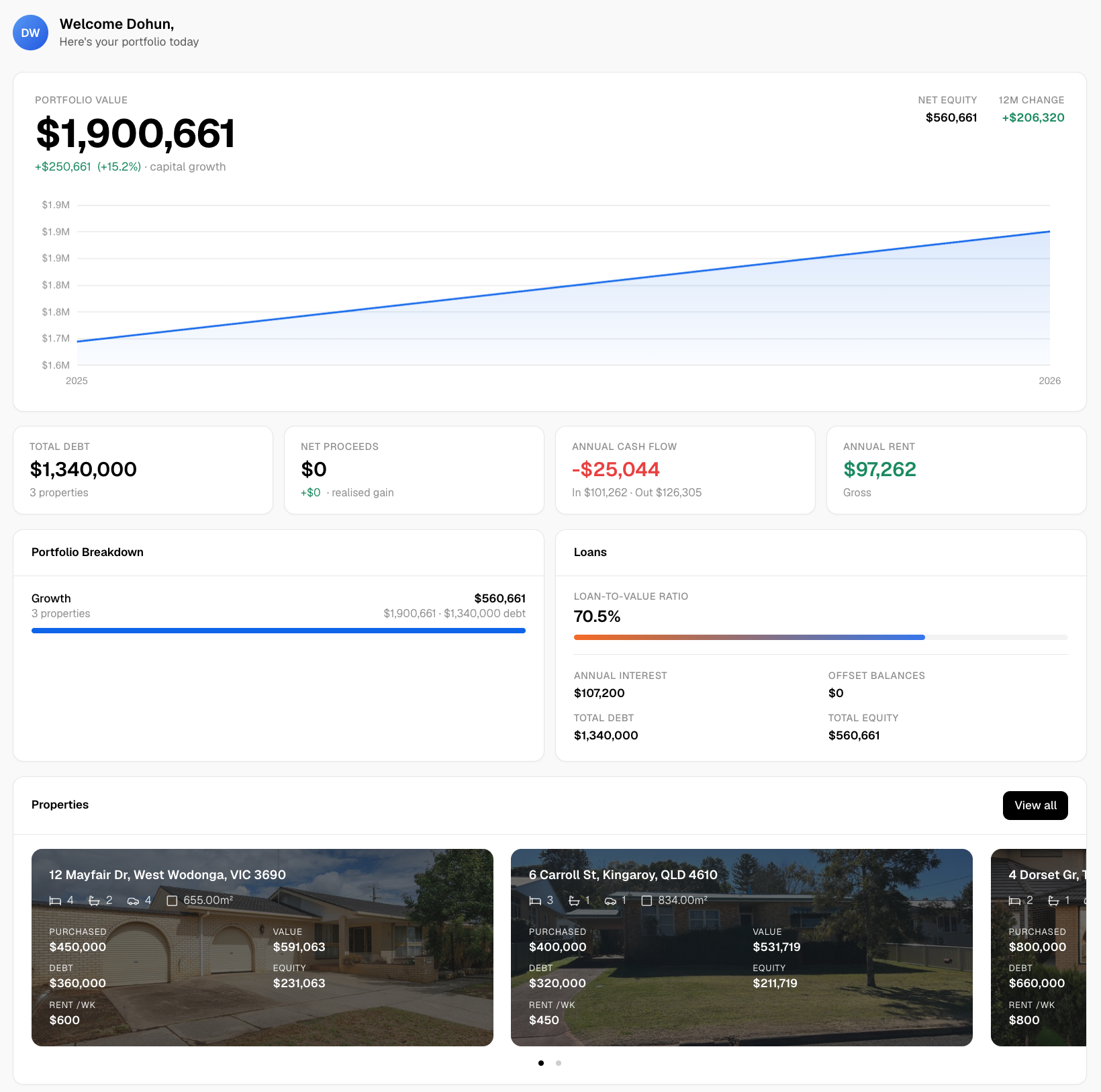
Try the WealthStacker toolkit or join the waitlist to start modelling your own scenarios.
FAQ
What is more profitable, renting long-term or Airbnb?
Airbnb often earns more per booked night, and can come out ahead in premium tourism locations. After occupancy, cleaning, fees and management, the gap is usually smaller, as the Victorian Parliamentary Budget Office found. Long-term renting gives more predictable income with lower costs, so run your own net figures.
What is the downside of Airbnb?
The main downsides are higher operating costs, more workload, more wear from frequent turnover and weaker demand in quieter months. You also face local rules such as registration, night caps, levies and strata restrictions. Treat these as costs to price in before you list.
Is there a limit on how many days I can list my property in Australia?
It depends on where you are. In Greater Sydney and some other NSW areas, non-hosted short-term rental is capped at 180 days a year, with bookings of 21 days or more exempt. Other states and councils have their own settings, so check with your council and state government.
Do I pay different tax on Airbnb and long-term rent?
Generally no. Both are declared as rental income, and expenses are apportioned by how much and how long the property is rented or available for rent. Ask a registered tax agent about your own situation, particularly if you also use the property.
Sources
- Short-term vs long-term rental, Covara
- Holiday rental legal requirements in Australia
- 90-day cap on short stay accommodation, Victorian Parliamentary Budget Office
- Short vs long-term letting, Sydney Morning Herald
- How to evaluate a property for short-term or long-term rental
- AHURI: Insights into short-term rental accommodation
- AHURI: Technological disruption in private housing markets
- Should I Airbnb my property? Krause and Aschwanden
- Ballina Shire Council STRA factsheet
- NSW Planning Portal: Rules for STRA
- ATO: Renting out a room or part of your main residence
- Airbnb tax guide for Australia
- Airbnb rules in Victoria compliance guide
- A coastal rental investment example in Spain