
AI Real Estate Investing in Australia: What Works and What to Check
AI is useful in property investing when you use it to speed up research, not to make the decision for you. It is good at pulling data together, screening suburbs, running scenarios and tracking a portfolio. It is weak at local nuance, physical condition and anything you have not told it. Used that way, it can save you hours and sharpen your questions before you spend money.
This guide covers what AI tools can do for Australian investors, how to test a property’s yield and cash flow with them, how to compare tools, and a checklist for verifying what they tell you.
Wealthstackerwealthstacker.com.auCompare Property Strategies With AIWealthStacker combines AI tools, quarterly valuations and modelling for rentvesting and buying to help you assess property decisions.Explore WealthStackerTL;DR
- AI works best as a research assistant: screening suburbs, summarising data, modelling scenarios and tracking a portfolio.
- Check every number a general chatbot gives you. A recent study found ChatGPT’s suburb picks for a $1 million budget were wrong in over half of tested cases.
- Automated valuations are a starting point. A 15% margin on a $1 million property is a $150,000 range, so get a valuer’s view before you commit.
- Choose tools by Australian data coverage, what they model, what they cost and whether they keep your numbers current.
- WealthStacker gives you free quarterly valuations and 15-year modelling for rentvesting and buying, so you can test a strategy before you act.
Table of Contents
- What AI can actually do for a property investor
- Types of AI property tools and what each does
- How to use AI to test yield, cash flow and returns
- Rentvesting or buying: where scenario modelling earns its keep
- Where AI goes wrong, and how to use it safely
- A checklist before you rely on any AI output
- How to compare AI property tools
- Using AI across your whole portfolio
- Where WealthStacker fits
- FAQ
- Sources
What AI can actually do for a property investor
Most Australian investors use AI in three jobs: researching markets, assessing individual properties and managing what they already own.
On research, API Magazine reports that AI is best at processing and analysing historical price data, economic indicators, interest rates and growth trends. That fits how the tools are built: they are fast at large datasets that would take you a weekend of spreadsheets.
UBS Asset Management describes AI as a “co-pilot” for real estate decisions. It can pull insights from unstructured data, forecast rental growth, assess demographics and surface comparable properties. It can also value properties through “mass appraisal”, which means automatic analysis of broad databases using self-learning models.
In practice that breaks down into five everyday uses:
- Suburb screening. Narrow a few hundred suburbs to a shortlist using price growth, rental demand, vacancy and demographics.
- Valuation estimates. Get an automated estimate of what a property, or your own home, is worth today.
- Scenario modelling. Project net worth over 10 to 15 years under different strategies.
- Borrowing power checks. Get a sense of what you could borrow before you talk to a lender.
- Portfolio tracking. See properties, shares and crypto in one place without maintaining a spreadsheet.
The common thread: AI shortens the time between a question and a first answer. The decision still sits with you.
Types of AI property tools and what each does
The market is crowded, so it helps to sort tools by the job they do rather than by brand.
| Tool type | What it does | Best for | Watch for |
|---|---|---|---|
| Automated valuation models (AVMs) | Estimate a property’s value from sales, attributes and market data | Quick value checks, tracking equity | Unique homes, condition, fast-moving suburbs |
| General chatbots | Answer questions, summarise articles, explain concepts | Learning, drafting questions for a broker or agent | Wrong or mismatched data, confident tone |
| Suburb and market research platforms | Show prices, rents, yields, demographics, hazards | Building a shortlist | Data age and local nuance |
| Scenario and planning tools | Model buy versus rentvest, net worth and borrowing | Choosing a strategy | Quality of your inputs |
| Portfolio dashboards | Track holdings and net worth across asset classes | Ongoing management | How often values refresh |
| Institutional analysis platforms | Deal underwriting for professionals | Developers, funds, analysts | Complexity and cost for a first-time buyer |
The two dominant AVM providers in Australia both use machine learning. According to PropertyGo, nearly 90% of one provider’s AVM valuations fall within 15% of the actual sale price, and both are used by more than 80% of the top 50 residential lenders. That is a useful sense of scale: these models are mainstream, and they are accurate enough to start a conversation, not to close one.
For a deeper look at how these models work, see our guide to automated property valuation models and the role of AI tools in property valuation.
How to use AI to test yield, cash flow and returns
The best use of AI on a single property is to do the arithmetic fast and expose your assumptions. Here is a simple routine.
Step 1: Start with the plain numbers
Gross rental yield is annual rent divided by purchase price. A property bought for $800,000 and rented at $650 a week earns $33,800 a year, a gross yield of about 4.2%. Any tool should reproduce that sum. If it does not, stop and find out why.
Step 2: Move to net cash flow
Gross yield ignores the costs that decide whether a property pays for itself. List them before you ask a tool anything:
- Loan interest and principal
- Council rates and water charges
- Insurance, including landlord cover
- Property management fees
- Maintenance and a vacancy allowance
- Strata or body corporate fees, if any
Ask the tool to show weekly cash flow with and without a vacancy allowance. If you are using a chatbot, paste in your own figures rather than letting it fill in the gaps. Chatbots will assume, and assumptions are where errors enter.
Step 3: Look at risk, not just return
A yield figure says nothing about flood, bushfire or coastal exposure, or about how much new supply is coming. Hazard overlays and suburb research tools help here. Check the local council’s planning information for developments nearby, since API Magazine notes that AI can overlook human factors such as community culture or the effect of a new development on values.
Step 4: Model the long run
Single-year yield tells you little about wealth. A 15-year model that includes growth, rent rises, loan paydown and costs is more informative. Our notes on ABS-based long-term property projections and ROI benchmarks show how to set reasonable assumptions rather than optimistic ones.
Step 5: Stress test
Run the same property with a higher interest rate, two extra months of vacancy and a lower growth rate. If the numbers still work, you have more confidence. If they only work in the best case, you have learned something cheaply.
Rentvesting or buying: where scenario modelling earns its keep
Many Australians face a choice that a single property calculator cannot answer: buy a home to live in, or keep renting where you want to live and invest elsewhere. This is rentvesting, and the right answer depends on your income, deposit, borrowing capacity, rent and what the alternative investment could return.
This is the kind of question AI-assisted modelling suits. You enter your situation once, then change one variable at a time: a cheaper suburb, a larger deposit, a different growth rate. Each change shows up as a different projected net worth.
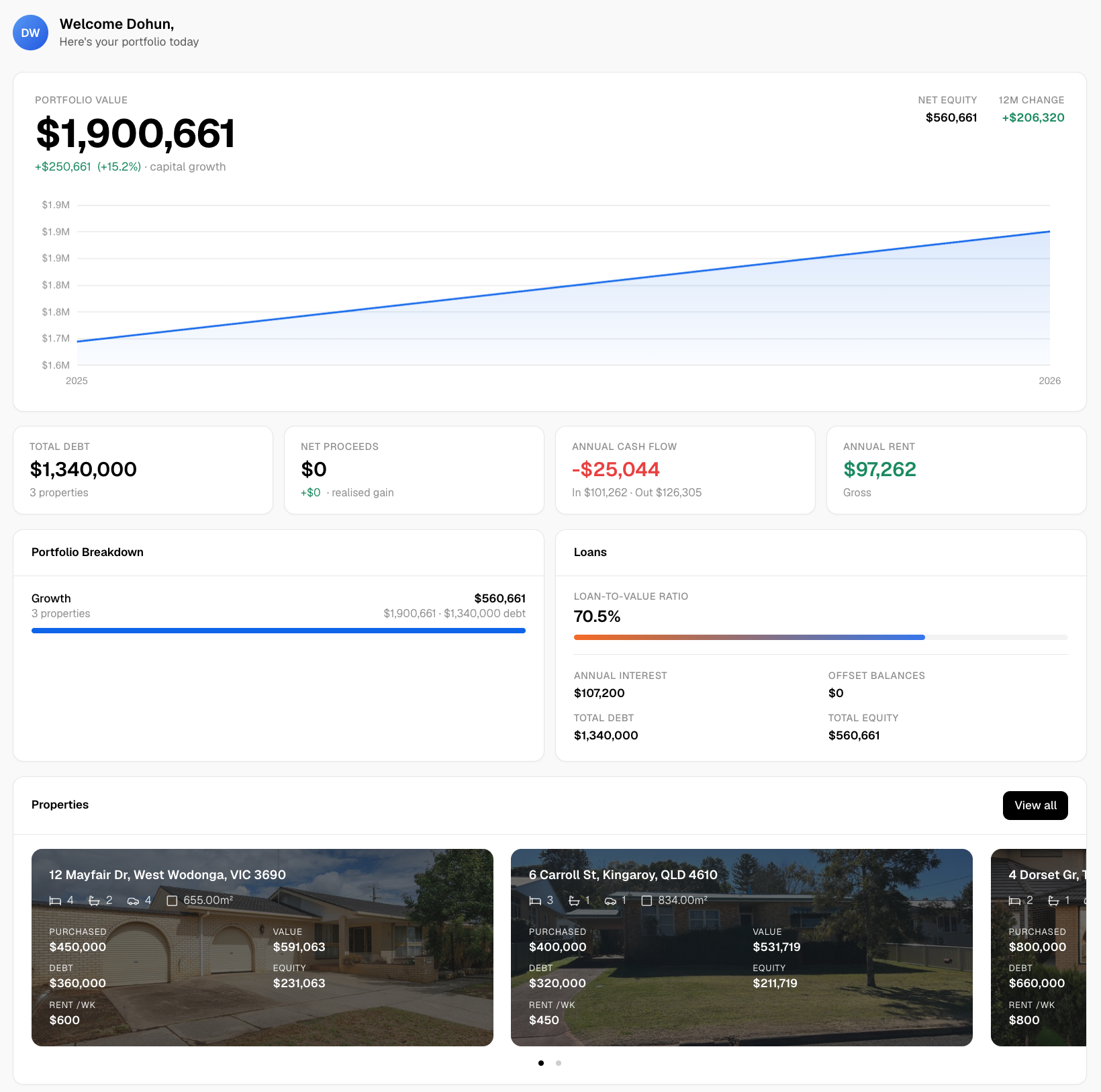
WealthStacker is built around this comparison. It models rentvesting against buying over 15 years, estimates borrowing power and lets you set goals and see how your net worth tracks against them. You get an answer to “what happens if” without building a spreadsheet from scratch.
Where AI goes wrong, and how to use it safely
The risks are real, and they are manageable if you know where they sit.
Chatbots can pick the wrong asset. In a study by MCG Quantity Surveyors, ChatGPT kept choosing units even though a $1 million budget could buy houses in the same locations. It also over-weighted rental yield and used incorrect or mismatched days-on-market and 12-month price-change figures. Reporting by Property Investment Professionals says its suburb recommendations were incorrect in over half of tested cases, and that results got worse in “deep research” mode.
Valuations have a margin. PropertyGo notes that AVMs cannot assess property condition, do not involve a physical inspection by a licensed valuer, struggle with unique properties with few comparable sales and can lag in fast-moving suburbs. A 15% margin on a $1 million property is a $150,000 range. Treat an automated value as a research starting point.
Blind spots are local. Property Investment Professionals lists hallucinations, micro-market blindness and supply pipeline gaps as the main risks. A model can tell you a suburb has strong growth. It may not know the next street is about to get 400 new apartments.
Your data needs protecting. API Magazine warns that AI platforms often ask for personal financial data, which raises privacy and security questions. Before you connect accounts or upload documents, read the privacy policy, check where data is stored and share only what the tool needs.
The law has nuances. Ms Mercorella, quoted by news.com.au, cautions that AI may not correctly interpret legal nuances, which could lead to unintentional breaches of legislation. Contracts, zoning and tax treatment are for a conveyancer, solicitor or accountant to confirm.
The right response is not to avoid AI. It is to give it the right job.

A checklist before you rely on any AI output

Borrow the spirit of what industry voices recommend. Mr Mortlock, quoted by news.com.au, sums it up: keep humans in the loop, validate every number, and use AI to accelerate due diligence, not replace it. UBS makes the same point from the professional side: people still need to review AI output before it is relied on for decisions, even as AI speeds up analysis and widens its breadth.
Property Investment Professionals offers a handy rule of thumb, the “20% confidence rule”: let AI supply about 20% of your conviction and human verification the other 80%. Here is how that looks in practice.
- Ask for the source and date of every figure. If the tool cannot say where a median price or vacancy rate came from, do not use it.
- Cross-check against a second source. Compare sold prices and rents with listings, public sales records and an agent’s view.
- Confirm property type and budget logic. Does the suggestion match what you can actually buy, houses or units, in that suburb?
- Inspect in person. Condition, noise, street feel and neighbours do not appear in a dataset.
- Get a valuer or building inspection before an offer if the margin matters to you.
- Run the finance with a broker or lender. Borrowing estimates are indicative until a lender assesses you.
- Take advice on tax and legal questions from a licensed accountant or solicitor.
- Write down your assumptions and revisit them when rates, rents or your income change.
The point of the checklist is to make the AI work harder for you, not to make you work harder than before. Done well, you spend your time on the 20% of checks that matter.
How to compare AI property tools
With dozens of options, a few criteria separate the useful from the noisy.
| Criterion | What to ask |
|---|---|
| Australian data coverage | Does it cover your target suburbs, property types and recent sales? |
| What it models | Valuation only, or also cash flow, borrowing power and long-term scenarios? |
| Data freshness | How often do valuations and market data refresh? |
| Portfolio scope | Can it track property, shares and crypto together? |
| Transparency | Does it show inputs, assumptions and dates? |
| Privacy | What data does it need, and how is it stored? |
| Cost | Is there a free tier, and what does the paid plan add? Check the current price on the provider’s own site. |
| Effort | Can you get a result without building a spreadsheet? |
Pricing changes often, so confirm it on the provider’s own page on the day you decide. Our guides to low-effort investment analysis platforms and time-efficient investment decision tools walk through these criteria in more depth.
A note on professional-grade platforms. Some tools are built for institutions that underwrite large deals with teams of analysts. If you are a first-home buyer, a renter weighing a first investment or an individual with a few properties, you will usually get more from tools designed for individuals, with plain-language outputs.
Using AI across your whole portfolio
Research is only half of the job. Once you own assets, the work shifts to tracking: what is each worth, how are loans tracking, and is your net worth moving toward your goals?
AI helps by automating the repetitive part. Automated valuations refresh property values, linked accounts update shares and crypto, and a dashboard rolls everything into one net worth figure. The Property Fund Association Australia reports that AI use cases that have worked well in funds management include chatbots that answer investor queries from fund documents and automated reports generated from data warehouses. The same logic applies at an individual level: let software do the collating, and spend your attention on decisions.
Our portfolio performance metrics checklist lists what to track, and the guide to AI property valuation and portfolio tracking shows how the pieces fit. If a valuation matters for a refinance or a purchase, read when you need a valuer first.
One more point from the same source: Larry Rudman says AI success depends less on budget than on mindset, noting that the tools are low cost and accessible, and that teams expecting instant perfection will be disappointed. For an individual investor that translates well. Expect a faster first draft, then refine it.
Where WealthStacker fits
WealthStacker is an investment toolkit for Australians who want to make property decisions with numbers in front of them. It includes:
- Free automated quarterly property valuations
- A portfolio dashboard for property, shares and crypto, designed to remove the spreadsheet
- 15-year modelling that compares rentvesting and buying
- Interactive goal and net worth planners
- An AI chat assistant for investment questions
- Market research tools for Australian suburbs
- Borrowing power estimates
- Hazard and risk overlays
If you are deciding between renting and buying, or want to see how an investment property would change your net worth, you can start with the WealthStacker toolkit and explore the features at your own pace.
Use it the way this article suggests: let it do the modelling and tracking, then bring the shortlisted property to a valuer, a broker and an inspector.
FAQ
Can AI find me a good investment property in Australia?
AI can build a shortlist of suburbs and flag properties that fit your criteria, but it should not make the final pick. A study of ChatGPT found its suburb recommendations were wrong in over half of tested cases. Use AI to narrow the field, then verify sales, rents and local conditions yourself.
Are AI property valuations accurate?
They are a good starting point. Nearly 90% of one major provider’s AVM valuations fall within 15% of the actual sale price, according to PropertyGo. On a $1 million property that is a $150,000 range, so use a licensed valuer when the number matters.
What is the best way to use AI chatbots for property research?
Give them your own figures and ask them to explain, calculate or summarise, rather than asking them to choose. Ask for sources and dates, then cross-check key numbers elsewhere. Use the chatbot to prepare better questions for your broker, agent or accountant.
Is it safe to share financial details with AI property tools?
API Magazine notes that AI platforms often require access to personal financial data, which raises privacy and security considerations. Read the privacy policy, share only what the tool needs and avoid uploading documents you do not have to.
Sources
- The future of property investing: can AI be trusted as an investment tool? (API Magazine)
- Investment decision making and other AI applications (UBS Asset Management Australia)
- How AI and PropTech Are Changing the Way Australians Buy Property (PropertyGo)
- AI fail: How ChatGPT is doing investors dirty (news.com.au)
- 7 AI Tools for Property Investors Australia 2026 (Property Investment Professionals)
- Beyond the hype: Property funds unlocking real AI value (Property Fund Association Australia)