
AI property valuation portfolio tracking: 2026 guide
TL;DR:
- AI property valuation portfolio tracking uses automated models to monitor property values and portfolio performance in real time. It replaces manual appraisals with continuous updates but requires digitised, standardized data for accuracy and compliance. Combining AVMs with rental analytics, human review, and formal appraisals ensures reliable investment decision-making.
AI property valuation portfolio tracking is the practice of using Automated Valuation Models (AVMs) and AI-driven analytics to monitor, measure, and manage the value of investment properties in real time. Australian investors are adopting this approach to replace slow, expensive manual appraisals with automated data feeds that update portfolio metrics continuously. Lenders already use AVMs extensively for refinancing properties with LVR below 80%, saving $300 to $600 per valuation and accelerating approvals by days. That same technology is now available to individual investors managing their own portfolios. Wealthstacker is one platform built specifically for this purpose, offering automated quarterly valuations and real-time net worth modelling for Australian property investors.
What AI tools are essential for property valuation portfolio tracking?

The foundation of any AI-driven portfolio tracking system is the AVM. An AVM uses comparable sales data, property attributes, and market trend algorithms to produce a property value estimate without a physical inspection. AVMs for standard metropolitan residential properties in Australia typically fall within 5–8% of formal bank valuations. That accuracy level is sufficient for ongoing portfolio monitoring, though not for formal lending decisions.
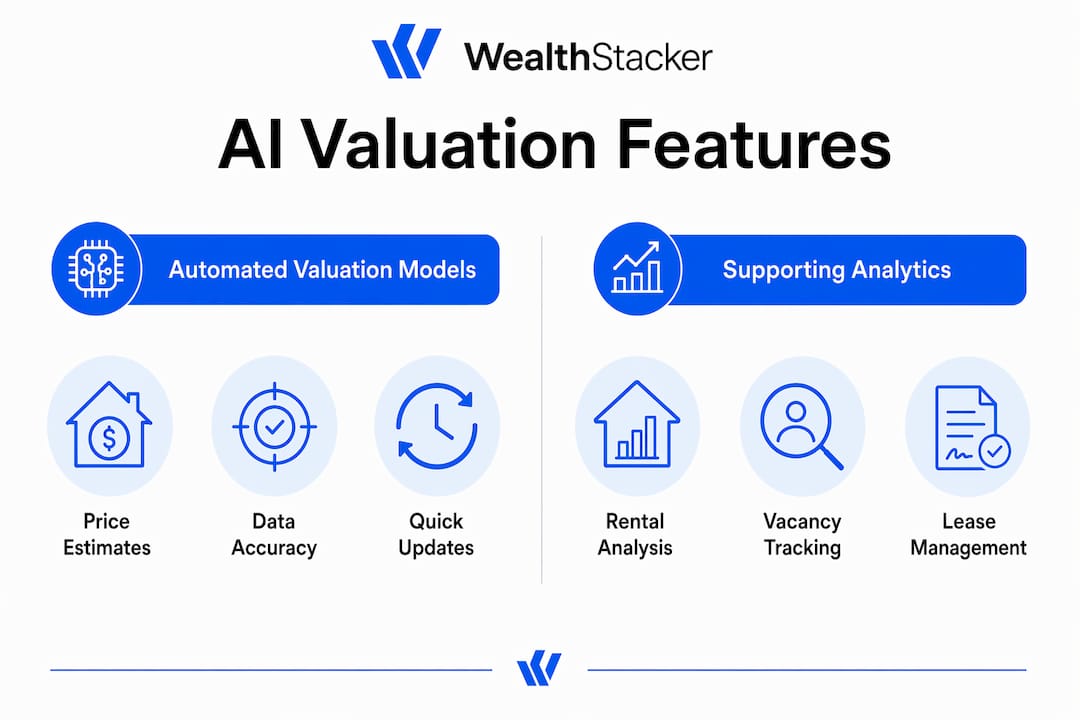
Beyond AVMs, effective AI investment property analysis requires rental analytics, vacancy rate tracking, and lease management tools. These modules pull live rental data from listing platforms and compare your current rents against suburb medians. AI-integrated arrears modules, for example, reduce average days in arrears by 41% compared to manual processes. That kind of operational improvement compounds across a multi-property portfolio.
The table below compares the core AI feature categories investors should look for when evaluating property valuation tools.
| Feature category | What it does | Why it matters |
|---|---|---|
| Automated Valuation Models | Estimates property value using comparable sales and algorithms | Replaces costly formal appraisals for routine monitoring |
| Rental analytics | Tracks market rents and vacancy rates by suburb | Identifies underperforming assets and repricing opportunities |
| Portfolio dashboard | Aggregates equity, yield, and cash flow across all properties | Gives a single view of total portfolio performance |
| Lease management | Automates lease renewals, rent reviews, and compliance alerts | Reduces administrative lag and missed review dates |
| Reporting and alerts | Sends automated notifications when values or yields shift | Enables faster decisions without manual data checking |
Pro Tip: The most common integration failure is connecting AI tools to data that has not been digitised or standardised. Before subscribing to any platform, audit your existing records. Mismatched lease formats, inconsistent address fields, and paper-based expense records will nullify the benefits of any AI system you layer on top.
Successful AI integration requires a governed data layer with digitised, standardised assets and leases. This is not optional. Investors who skip this step find that their AI outputs are unreliable because the underlying data is incomplete or inconsistent.
How to use AI-driven property valuation for real-time portfolio tracking
Building a real-time portfolio tracking system with AI follows a clear sequence. Skipping steps creates gaps in your data that undermine the accuracy of every metric downstream.
- Digitise and centralise your property records. Scan all leases, title documents, and expense records into a single digital system. Standardise address formats and property identifiers across every file.
- Connect an AVM feed to each property. Most AI property platforms allow you to link individual properties by address. The platform then pulls automated valuation updates on a set schedule, typically monthly or quarterly.
- Set your baseline metrics. Record the purchase price, current loan balance, and initial rental income for each property. These figures form the benchmark against which AI outputs are measured.
- Interpret confidence scores correctly. Most AVM outputs include a confidence score or valuation range. A narrow range on a standard suburban house signals high reliability. A wide range on a rural property or a heavily renovated home signals low reliability. Treat low-confidence outputs as indicative only.
- Integrate rental and vacancy analytics. Link your rental data to the portfolio dashboard so that yield calculations update automatically when market rents shift. This removes the manual step of recalculating yield every time a tenancy changes.
- Build alerts for threshold events. Set notifications for when a property’s estimated value drops below a set equity threshold, when vacancy extends beyond a target number of days, or when rental yield falls below your minimum acceptable return.
- Review the full portfolio view monthly. Use the aggregated dashboard to compare equity growth, cash flow, and yield across all properties. Identify which assets are performing and which are dragging the portfolio down.
Top AI property platforms combine AVMs, rental analytics, tenant screening, and real-time dashboards to save investors hours each week. The time saving is real, but the greater benefit is decision quality. When you can see all your metrics in one place, updated automatically, you make fewer reactive decisions based on stale data.
Australian market conditions add a layer of complexity worth noting. Suburb-level data quality varies significantly between capital cities and regional markets. Sydney and Melbourne have deep comparable sales pools, which makes AVM outputs more reliable. Regional Queensland or rural Western Australia have thinner data sets, which widens valuation ranges and reduces confidence scores. Adjust your reliance on AI outputs accordingly. For investment property forecasting in thin markets, pair AI estimates with local agent appraisals at least once per year.
What are the common challenges when using AI for property valuation?
AI valuation tools have real limitations that investors must understand before relying on them for decisions. The most significant is accuracy degradation in complex or thinly traded markets. AVM accuracy for standard metropolitan properties sits within 5–8% of formal valuations, but that figure worsens for unique homes, extensively renovated properties, or suburbs with fewer than a handful of comparable sales per quarter.
The regulatory environment adds another layer of risk. Australian regulations require transparency in price estimation, and “black box” AI tools that cannot explain their outputs pose compliance and liability risks. If you use an AI valuation to advise a co-investor or a tenant on pricing, accountability rests with you, not the software provider. This is not a theoretical risk. State-level agent conduct guidelines are explicit on this point.
Generative AI tools present a separate problem. Models like ChatGPT show over 50% failure rate in fact-checking property investment recommendations. They hallucinate statistics, miss key risk flags, and present confident-sounding outputs that are factually wrong. Using generative AI to research market conditions or evaluate a deal without independent verification is a material risk.
Common mistakes investors make when using AI valuations exclusively:
- Treating AVM outputs as equivalent to formal bank valuations for lending or legal purposes
- Ignoring confidence scores and acting on wide-range estimates as if they were precise
- Using AI-generated suburb reports without checking the data vintage or sample size
- Relying on generative AI for investment advice without cross-checking against current market data
- Failing to update property records in the platform, which causes AI outputs to drift from reality
Only 40% of Australian buyers were willing to accept AI-driven valuations as of mid-2026. That cautious attitude reflects a genuine gap between what AI can deliver and what investors expect. The gap closes when investors understand that AI is a research accelerator, not a replacement for professional judgement.
Pro Tip: Use AI valuation outputs to flag properties that warrant closer attention, then commission a formal appraisal for any asset where you are making a significant decision. This hybrid approach captures the efficiency of automation without exposing you to the liability of acting on an unreliable estimate.
For a deeper look at portfolio performance benchmarking, including how to set meaningful benchmarks alongside AI outputs, Wealthstacker’s guide covers the methodology in detail.
How to integrate AI property valuation tracking into your investment workflow
Integrating AI into your existing workflow is less about technology and more about process discipline. The tools only deliver value when they are connected to accurate data and reviewed consistently.
The table below compares a manual workflow against an AI-enhanced workflow across the key tasks in real estate portfolio management.
| Task | Manual workflow | AI-enhanced workflow |
|---|---|---|
| Property valuation | Annual formal appraisal at $300–$600 per property | Automated AVM updates monthly or quarterly at no additional cost |
| Rental benchmarking | Periodic agent review, often delayed | Real-time suburb rental data integrated into dashboard |
| Cash flow tracking | Spreadsheet updated manually each month | Automated income and expense aggregation with alerts |
| Lease management | Calendar reminders and paper files | Automated renewal alerts and compliance notifications |
| Portfolio reporting | Manual compilation, hours of work | One-click report generation from live data |
The efficiency gains are clear. The more important shift is in decision quality. When data is current and aggregated, investors spot problems earlier and act with more confidence.
Follow this checklist to implement AI property valuation tracking in your portfolio:
- Audit all existing property records and convert paper files to digital formats.
- Standardise property identifiers, addresses, and financial data across all records.
- Select a platform that includes AVMs, rental analytics, and a portfolio dashboard suited to Australian market data.
- Connect each property to the platform and verify that the initial AVM output is within a reasonable range of your last formal valuation.
- Set monthly calendar reminders to review dashboard metrics and act on any alerts generated by the system.
- Schedule an annual formal appraisal for any property where you plan to refinance, sell, or make a significant capital decision.
- Document your AI tool usage and data sources to support compliance obligations under Australian agent conduct guidelines.
AI in real estate is best applied as a research accelerator. Human judgement remains essential, particularly in risk assessment and complex cases. The investors who get the most from these tools are those who use AI to surface the right questions, then apply their own knowledge and professional advice to answer them.
Wealthstacker’s portfolio tracker for AI valuation strategy
Wealthstacker is built for Australian property investors who want automated valuation and real-time portfolio tracking without the complexity of enterprise-grade platforms.
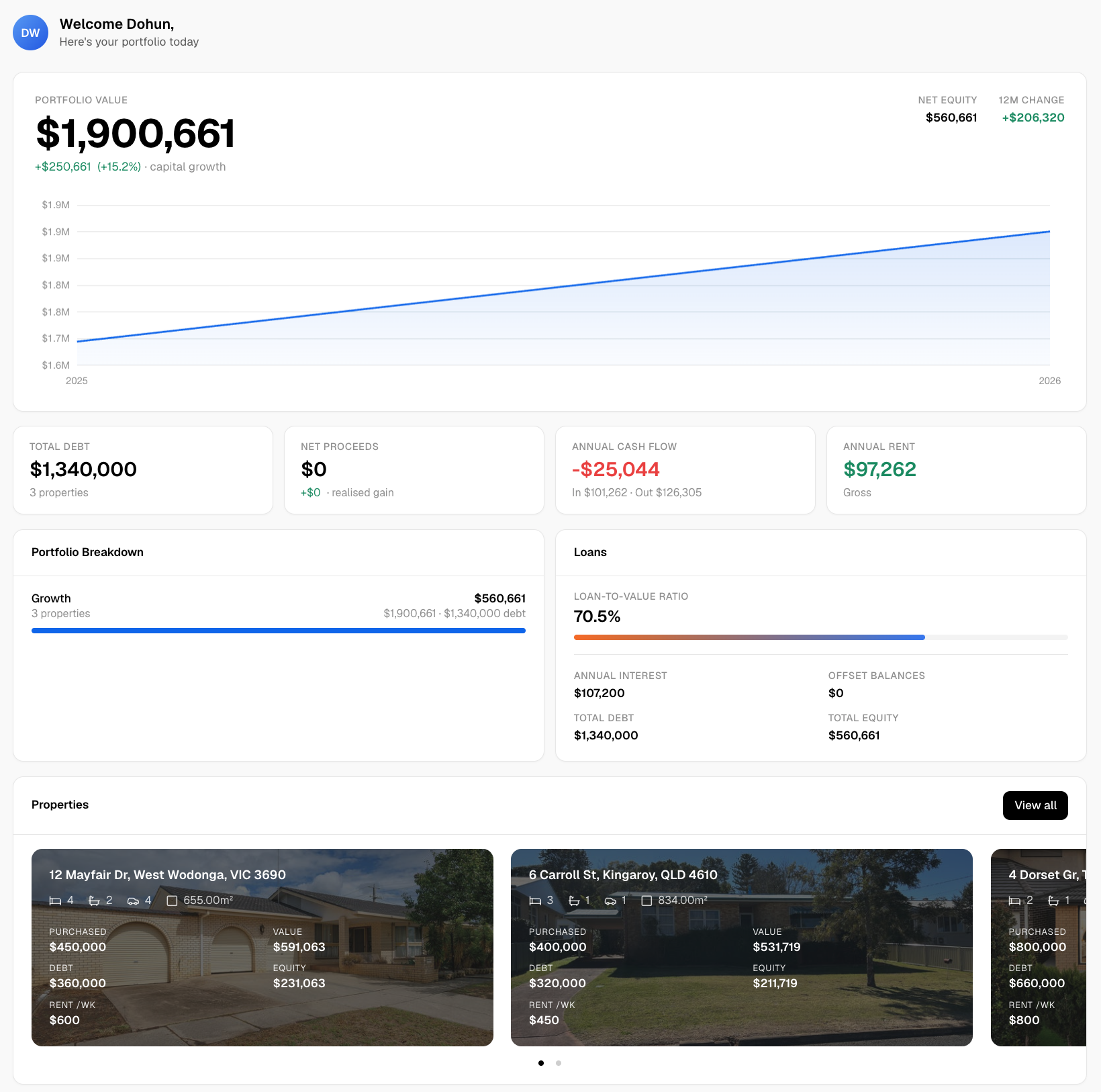
The platform delivers automated quarterly valuations at no cost, integrates AI modelling for both rentvesting and direct ownership strategies, and lets investors assess their net worth position in real time. Wealthstacker also supports borrowing power calculations and wealth accumulation forecasts, which makes it useful at every stage of a portfolio’s growth. For investors who want a practical, Australian-market-specific tool to put the methods in this guide to work, the Wealthstacker portfolio tracker is worth exploring.
Key takeaways
AI property valuation portfolio tracking delivers the most value when AVMs are combined with rental analytics, governed data, and regular human review to manage accuracy and compliance risks.
| Point | Details |
|---|---|
| AVM accuracy has limits | AVMs fall within 5–8% of formal valuations for standard metro properties but widen significantly for complex or regional assets. |
| Data quality determines output quality | Digitised, standardised property records are a prerequisite for reliable AI valuation outputs. |
| Generative AI carries high error risk | AI models show over 50% failure rates in fact-checking investment advice, so human oversight is non-negotiable. |
| Compliance rests with the investor | Australian regulations require transparent price estimation; liability for AI-generated valuations sits with the user, not the tool. |
| Hybrid workflows outperform either extreme | Combining automated AI tracking with annual formal appraisals captures efficiency gains without sacrificing decision accuracy. |
FAQ
What is AI property valuation portfolio tracking?
AI property valuation portfolio tracking is the use of Automated Valuation Models and AI-driven analytics to monitor property values, rental yields, and portfolio performance in real time. It replaces manual appraisals with automated data feeds that update continuously.
How accurate are AI property valuations in Australia?
AVMs for standard metropolitan residential properties in Australia typically fall within 5–8% of formal bank valuations. Accuracy declines for complex properties, renovated homes, and thinly traded regional markets.
Can I use AI valuations for refinancing decisions?
AI valuations are useful for monitoring portfolio equity, but lenders require formal bank valuations for refinancing decisions. Use AVM outputs to identify when refinancing may be worth pursuing, then commission a formal appraisal to confirm.
What are the compliance risks of using AI valuation tools in Australia?
Australian regulations require transparency in price estimation. Black-box AI tools that cannot explain their outputs pose compliance and liability risks for investors who use them in an advisory capacity. Always document your data sources and decision rationale.
How does Wealthstacker support AI property valuation tracking?
Wealthstacker provides automated quarterly valuations, real-time net worth modelling, and portfolio dashboards tailored to Australian market conditions. The platform supports both rentvesting and direct ownership strategies, with borrowing power and wealth accumulation forecasts included at no cost.